


GMADA & Infrastructure News
GB Realty Acquire Downtown Mohali For Which Everyone Is Talking About
GB Realty has officially taken over the Downtown Mohali commercial project in Sector 62, bringing RERA-approved shops, s...
PUDA Punjab, the Punjab Urban Planning and Development Authority, has quietly shaped how Punjab grows since 1995. This guide walks you through…PUDA Punjab, the Punjab Urban Planning and Development Authority, has quietly shaped how Punjab grows since 1995. This guide walks you through its full history, how it differs from GMADA, its e-auction process, building rules, NOC procedure and how it protects every homebuyer's hard-earned investment across the state.







If you have ever tried to buy a plot in Punjab, chances are someone has already told you to check with PUDA Punjab first. PUDA is not just another government office you visit once and forget about.
It is the reason Mohali has organised sectors instead of random lanes, the reason your neighbour's illegal extension eventually gets a notice and the reason your title documents actually hold up in court.
For thousands of families across the state, PUDA has been the quiet gatekeeper standing between a safe investment and a lifetime of legal trouble.
In this guide, we will walk through everything this authority does, where it came from, how it works today and why understanding it properly could save you lakhs of rupees.
Smart investors know that acquiring the right property is the cornerstone of long-term wealth. With Acquire Estate’s expert guidance on market trends, due diligence and strategic financing, you can confidently secure high-potential properties. Start evaluating opportunities today and turn property investment into your greatest asset.
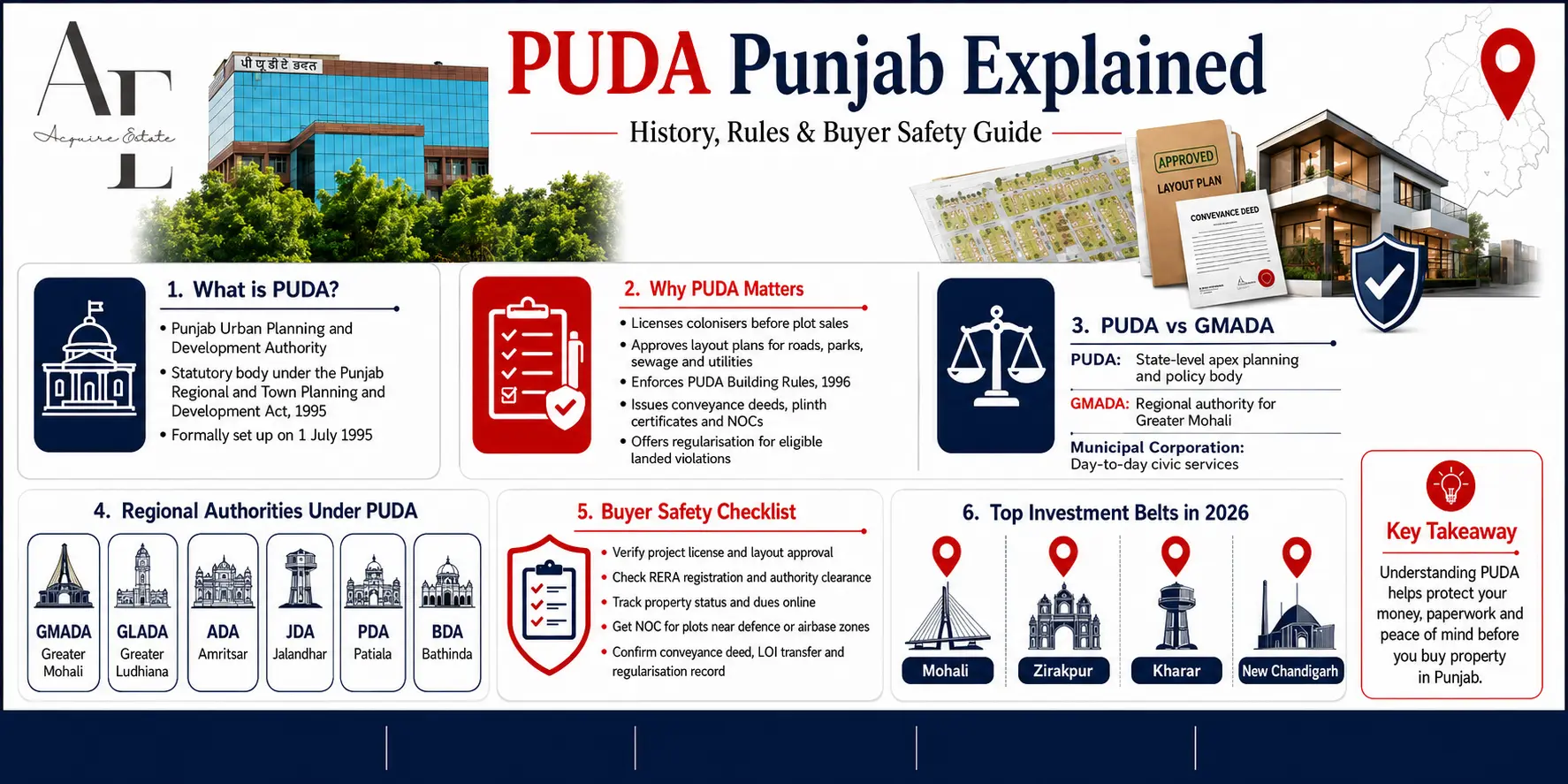
Let's start with the basics, because a surprising number of buyers never actually learn the PUDA full form. PUDA stands for the Punjab Urban Planning and Development Authority. It is a statutory body, meaning it was not created by a mere office order but by an Act of the Punjab Legislature, the Punjab Regional and Town Planning and Development Act, 1995. PUDA was formally set up under this Act on 1 July 1995.
Before PUDA existed, urban growth in Punjab was messy. Colonies came up wherever someone had land and a bit of capital, roads were an afterthought and buyers had almost no way to verify whether a plot was even legal.
The government of the time felt the pressure of this haphazard growth and decided something had to change. Alongside PUDA, the state also brought in the Punjab Apartment and Property Regulation Act, 1995, which regulated how private colonisers and builders could sell property.
The same government also announced a general amnesty, regularising unauthorised properties that existed before 1995, giving thousands of families a clean legal slate to start from.
So how does this authority work in practice? Think of it as the planning brain of urban Punjab. It prepares long-term strategic plans and detailed local area plans for cities and towns, decides how land gets used and grants licences to private colonisers who want to build townships, provided they follow its planning norms.
Every institution has an origin story and this one is tied closely to Punjab's urbanisation journey. Once towns like Mohali, Ludhiana and Jalandhar started attracting more residents than their old municipal systems could handle, the state realised individual towns could not plan in isolation anymore. Growth was spilling across municipal boundaries and someone needed to think regionally.
That is precisely why the 1995 Act created PUDA as an apex, umbrella institution rather than a single-city body. A few years later, between 2006 and 2007, the government carved out six regional development authorities Punjab wide, each responsible for planning within its own patch of the state.
GMADA for Greater Mohali, GLADA for Greater Ludhiana, ADA for Amritsar, JDA for Jalandhar, PDA for Patiala and BDA for Bathinda were all born from this restructuring.
PUDA did not disappear. It settled into the role of the parent body, setting policy and coordinating regional work so the whole state grows in a connected way rather than as isolated pockets.
The headquarters of this entire system is a building most Tricity residents know well, PUDA Bhawan, Sector 62, SAS Nagar. This is where estate officer Punjab staff sit, where land acquisition hearings are held and where much of the state's development machinery actually runs from, even for regions like GMADA that have their own office space within the same premises.
The purpose behind all of this was never just administrative tidiness. It was buyer protection, long before RERA arrived in the year 2016.
By licensing colonisers, approving layout plans and enforcing building norms, PUDA gave ordinary buyers a way to check whether a project was legitimate before signing a cheque.
This is the part most blogs skip, but it is the part that actually affects your bank balance. Here is how this statutory body urban development Punjab relies on protects the people who are buying, not just the ones building.
It licenses colonisers before they can sell a single plot, so unauthorised colonies are flagged early rather than after your money has already changed hands.
It approves layout plans, meaning roads, sewage, parks and electricity infrastructure are accounted for on paper before a spade ever touches the ground.
It enforces the PUDA building rules 1996, so a builder cannot quietly add illegal floors and pass the risk on to you.
It runs a regularisation mechanism for older, non-compliant constructions, giving genuine buyers a legal path forward instead of leaving them stuck with an illegal structure.
It issues plinth level certificates and executes the conveyance deed, the actual paper trail that proves a property is legally yours.
It offers an NOC process for construction near sensitive zones, protecting both security interests and the buyer from future demolition orders.
None of this is glamorous. But every single one of these functions exists because, without them, an ordinary family buying their first plot would have almost no way of knowing whether they were walking into a legal minefield.
This is probably the single most confusing question for every buyer who is going to buy property in the Tricity region, so let's untangle it properly.
Feature | PUDA | GMADA | Local Municipal Corporation |
Scope | Entire state of Punjab | Greater Mohali region (Mohali, Zirakpur, Kharar, Banur, Derabassi) | A single city or town |
Role | Apex policy and planning body | Regional implementation authority under PUDA | Civic body for daily municipal services |
Established | 1995 | 2006 | Varies by city |
Main function | State-level master plans, regulation, coordination | Land development, plot allotment, sector planning | Water supply, sanitation, property tax, local roads |
Legal backing | Punjab Regional and Town Planning and Development Act, 1995 | Same Act, as a Regional Development Authority | Punjab Municipal Corporation Act |
So when someone asks you about PUDA vs GMADA, the simplest way to remember it is simple: PUDA is the parent policy body for the whole state, while GMADAis one of its regional children, focused entirely on the Greater Mohali belt. A local municipal corporation is a completely different animal altogether, handling day-to-day civic functions once a colony is already built and occupied. If you are researching PUDA vs GMADA vs local municipal corporation Punjab, remember all three can technically have a say over the same plot, depending on its stage of development.
Is PUDA is still functional or has it merged with GMADA?This question comes up often and the honest answer is that PUDA is very much alive. A merger was proposed back in 2015 but was never implemented.
As of 2026, PUDA continues to function as the apex authority, with the Chief Secretary of Punjab now holding the position of Chairman following a 2024 cabinet decision, while GMADA and the other regional bodies operate as its implementing arms.
PUDA jurisdiction areas in Punjab technically cover the entire state, but on the ground, six regional development authorities do most of the direct work.
Regional Development Authority | Primary Region Covered |
GMADA (Greater Mohali) | PUDA Mohali belt: Mohali, Zirakpur, Kharar, Banur, Derabassi, New Chandigarh |
GLADA (Greater Ludhiana) | Ludhiana and surrounding urban belt |
ADA (Amritsar) | Amritsar city and periphery |
JDA (Jalandhar) | Jalandhar and nearby townships |
PDA (Patiala) | Patiala city and expansion zones |
BDA (Bathinda) | Bathinda and adjoining areas |
Smaller towns without a dedicated regional authority still fall under PUDA's direct planning umbrella, with Improvement Trusts or local bodies implementing its policies on the ground.
If you are searching for PUDA plots for sale, the e-auction route is where most fresh allotments happen today. PUDA and its regional authorities regularly conduct auctions for residential, commercial, institutional and chunk sites through an online portal.
Here is roughly how the PUDA e-auction 2026 residential plots Mohali process tends to work, based on recent official notices.
Watch for an official auction notice on the PUDA or relevant regional authority website, listing available sites and reserve prices.
Register on the official e-auction portal and complete your KYC before the bidding window opens.
Submit your bid before the deadline mentioned in the notice, since these windows typically stay open for a few weeks.
If you win, you usually need to deposit around 12 percent of the bid amount to confirm allotment.
Many auctions offer a rebate, often around 15 percent, if you clear the full balance in a lump sum within 90 days, which is worth factoring into your budgeting.
.Once dues are cleared, the property becomes eligible for bank mortgage and empanelled lenders can step in to finance the rest.
A quick word of caution here. Auction schedules, reserve prices and rebate percentages change from one notice to the next, so always cross-check the live notice on the official portal before committing any money.
Once you have applied for a plot, tracking your PUDA property status should become a habit rather than a one-time check. The official portal lets you enter your application number to see exactly where your file stands.
You can also link your mobile number to your property for verification and check your Unique Property Number or UPN, which acts as your property's digital identity within the system.
This same portal is where you handle another practical task, how to pay PUDA property dues online. Outstanding instalments, interest or other charges linked to your property can be viewed and cleared directly, without visiting the office in person.
Given how often possession delays and payment disputes come up in Tricity real estate conversations, checking this portal every few months is simply good financial hygiene.
A PUDA NOC application becomes necessary in specific situations and one of the most common is PUDA NOC for building near defence establishment sites. If your plot falls within a certain distance of a cantonment, airbase or similar sensitive installation, you cannot simply start construction. You need a No Objection Certificate first.
Submit an application with your site plan, ownership documents and the proposed construction height and design.
The application gets reviewed against the defence and aviation safety guidelines, since height restrictions near airbases are taken seriously.
Once cleared, you receive the NOC, which then needs to accompany your building plan approval.
Skipping this step is a genuine risk. Buildings constructed without the required NOC near defence zones have faced demolition orders in the past, so this is not a formality worth brushing aside.
The PUDA building rules 1996 lay down what you can and cannot construct, covering everything from setbacks and floor area ratio to parking norms and maximum height. Builders and individual owners alike are expected to follow these rules when submitting plans for approval.
But what happens if construction has already deviated from the approved plan? This is where the PUDA regularization policy comes in. Instead of an automatic demolition order, PUDA allows certain violations to be compounded, meaning you pay a composition fee for the building violation and the deviation gets legally regularised, provided it falls within permissible limits and does not compromise structural or public safety.
This matters enormously for resale buyers. If you are purchasing an older house, always ask whether any composition fee has been paid and whether the structure carries a valid regularisation certificate. A property with unresolved building violations can complicate your loan approval, your resale value and in worst cases, your ownership itself.
For older ownership and tenancy questions that predate PUDA itself, see our Punjab Land Reforms Act 1972 guide.
Three documents come up again and again in PUDA transactions and understanding them can save you from a nasty surprise later.
Conveyance deed PUDA: This is the final legal document that formally transfers ownership of a plot to you. Until this deed is executed, your ownership technically remains incomplete on paper, even if you have paid the full amount.
Letter of intent transfer property: Many buyers purchase plots secondhand, on the basis of an LOI rather than a final conveyance deed. If you want to know how to transfer a PUDA plot allotment letter of intent into your own name, you apply through the concerned Estate Officer, submit the original LOI, proof of payment to the seller and identity documents, after which the transfer is processed and recorded.
Plinth level certificate: This certifies that your construction has reached plinth level in accordance with the sanctioned plan, confirming your foundation work is compliant before you invest further in the structure.
While allotment and pricing details shift constantly, a few belts under PUDA's regional authorities have consistently drawn buyer interest because of infrastructure momentum and connectivity. These are widely regarded among the best areas under PUDA for property investment.
Mohali and its GMADA-developed sectors, given proximity to Chandigarh International Airport and the IT corridor.
Zirakpur and Kharar, popular for highway connectivity and relatively accessible price points compared to core Mohali.
New Chandigarh, known for planned Eco City sectors and lower-density living, part of the wider master plan SAS Nagar vision.
Emerging pockets in Ludhiana and Patiala under GLADA and PDA, where infrastructure upgrades are gradually catching up with demand.
As always, verify RERA registration, layout approval and PUDA or GMADA clearance directly with the authority before finalising any purchase, rather than relying solely on a broker's word.
Understanding PUDA Punjab is not just an academic exercise for real estate enthusiasts. It is practical knowledge that protects your money, your paperwork and your peace of mind.
From its origins under the 1995 Act to its role today in e-auctions, NOC approvals and regularisation policies, PUDA has quietly stood as the backbone of organised urban growth across the state.
Whether you are comparing PUDA vs GMADA before choosing a plot, checking your property status online or simply trying to understand why PUDA Bhawan in Sector 62 matters so much to Tricity residents, it touches nearly every step of your property journey. Once the legal side is clear, our step-by-step guide to buying a flat in Mohali covers the rest.
The next time someone mentions PUDA Punjab in a property conversation, you will know exactly why this institution has earned its place as the guardian of the state's urban future and exactly how it protects the family before it protects the file.
Don’t let the perfect property slip away. Whether you’re seeking luxury homes, investment land, or legacy estates, our expert team makes acquisition seamless. Start building your future today - contact our team Acquire Estate. now for a personalized strategy and unlock exclusive opportunities. Your estate journey begins here.
All facts, dates and figures in this article have been cross-checked against the official PUDA and GMADA websites and recent authority notices. Auction prices, dues, rebate percentages and policy details change from time to time, so please verify current figures on puda.punjab.gov.in or with your concerned Estate Officer before making any financial decision.
PUDA is the Punjab Urban Planning and Development Authority, a statutory body set up in 1995 that plans, regulates and develops urban land across Punjab, working through six regional development authorities on the ground.
The PUDA full form is Punjab Urban Planning and Development Authority.
PUDA is the state-level apex authority covering all of Punjab, while GMADA is a regional authority under PUDA, responsible specifically for the Greater Mohali area.
Visit the official PUDA portal, enter your application number or linked mobile number and your current status, along with any dues, will be displayed.
PUDA remains fully functional as of 2026. A proposed merger in 2015 was never carried out and PUDA continues to function as the parent authority over GMADA and other regional bodies.
Log into the official PUDA portal using your Unique Property Number or application details, view outstanding dues and complete payment directly through the listed online options.
You typically need ownership documents, a site plan and proposed construction details, submitted for review against defence and aviation safety norms before construction begins.
It is a mechanism that allows certain building violations to be legalised through a composition fee, rather than facing automatic demolition, provided the deviation meets permissible safety limits.
PUDA's jurisdiction technically covers the entire state, with six regional development authorities, GMADA, GLADA, ADA, JDA, PDA and BDA, handling direct implementation in their respective regions.
Mohali, Zirakpur, Kharar and New Chandigarh remain strong picks due to connectivity and planned infrastructure, though every purchase should be verified with RERA and the relevant development authority first.
GB Realty has officially taken over the Downtown Mohali commercial project in Sector 62, bringing RERA-approved shops, s...
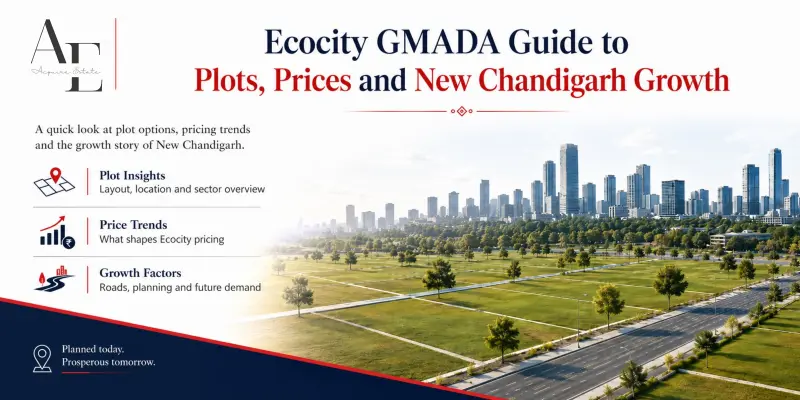
Ecocity GMADA is New Chandigarh's flagship plotted township, developed by the Greater Mohali Area Development Authority....

Haryana has retired its 2013 property tax rules and adopted a fresh, formula-based system built around Capital Value, Co...