

GMADA & Infrastructure News
GB Realty Acquire Downtown Mohali For Which Everyone Is Talking About
GB Realty has officially taken over the Downtown Mohali commercial project in Sector 62, bringing RERA-approved shops, s...
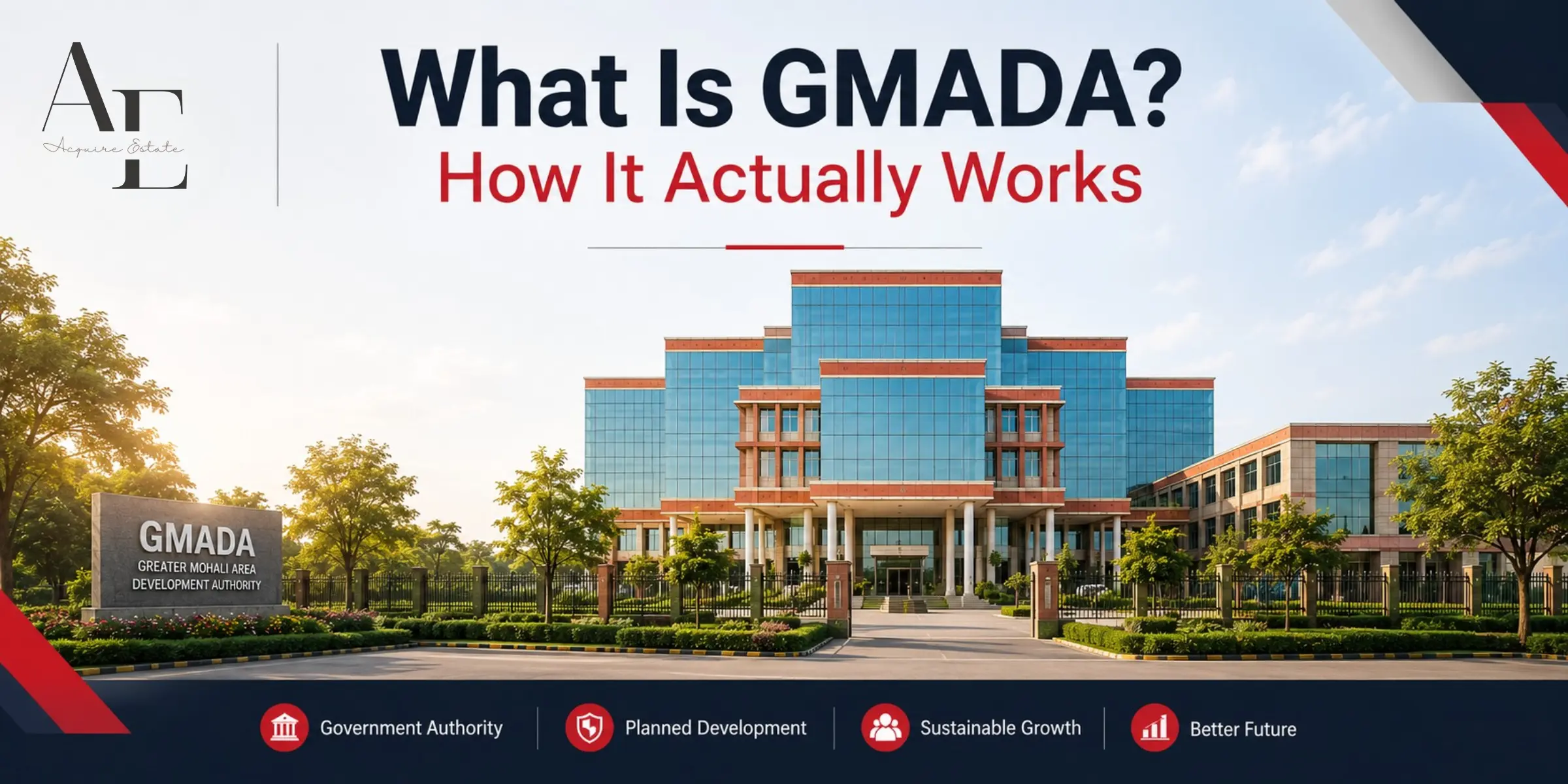
GMADA, the Greater Mohali Area Development Authority, plans and allots land across Mohali, Zirakpur, Kharar, Derabassi and New Chandigarh. This guide walks…GMADA, the Greater Mohali Area Development Authority, plans and allots land across Mohali, Zirakpur, Kharar, Derabassi and New Chandigarh. This guide walks you through its history, its land pooling scheme, Aerotropolis, Eco City 3, the Kurali master plan and the e-auction process, so you know exactly what you are buying before you sign anything.






Somewhere in a GMADA office in Sector 62, a file is moving from one desk to another right now and that single file might decide whether a family in Zirakpur finally gets the plot they have been waiting years to build a home on.
That is the quiet, unglamorous power that GMADA holds over the Tricity region. The Greater Mohali Area Development Authority, known to almost everyone simply as GMADA, draws the sector lines, decides where the roads will run and ultimately hands out the piece of land that so many families spend a lifetime saving for.
If you have ever wondered why one sector in Mohali feels planned and breathing room while a colony next door feels cramped, the answer almost always traces back to GMADA.
This blog is written for the person who wants the real story, checked against government notifications rather than sales brochures. We will walk through where this authority came from, how it functions, what protections it offers a buyer and which current schemes, from Aerotropolis to Eco City 3, are worth watching in 2026.
The body behind every sector number you have ever seen on a Mohali property card
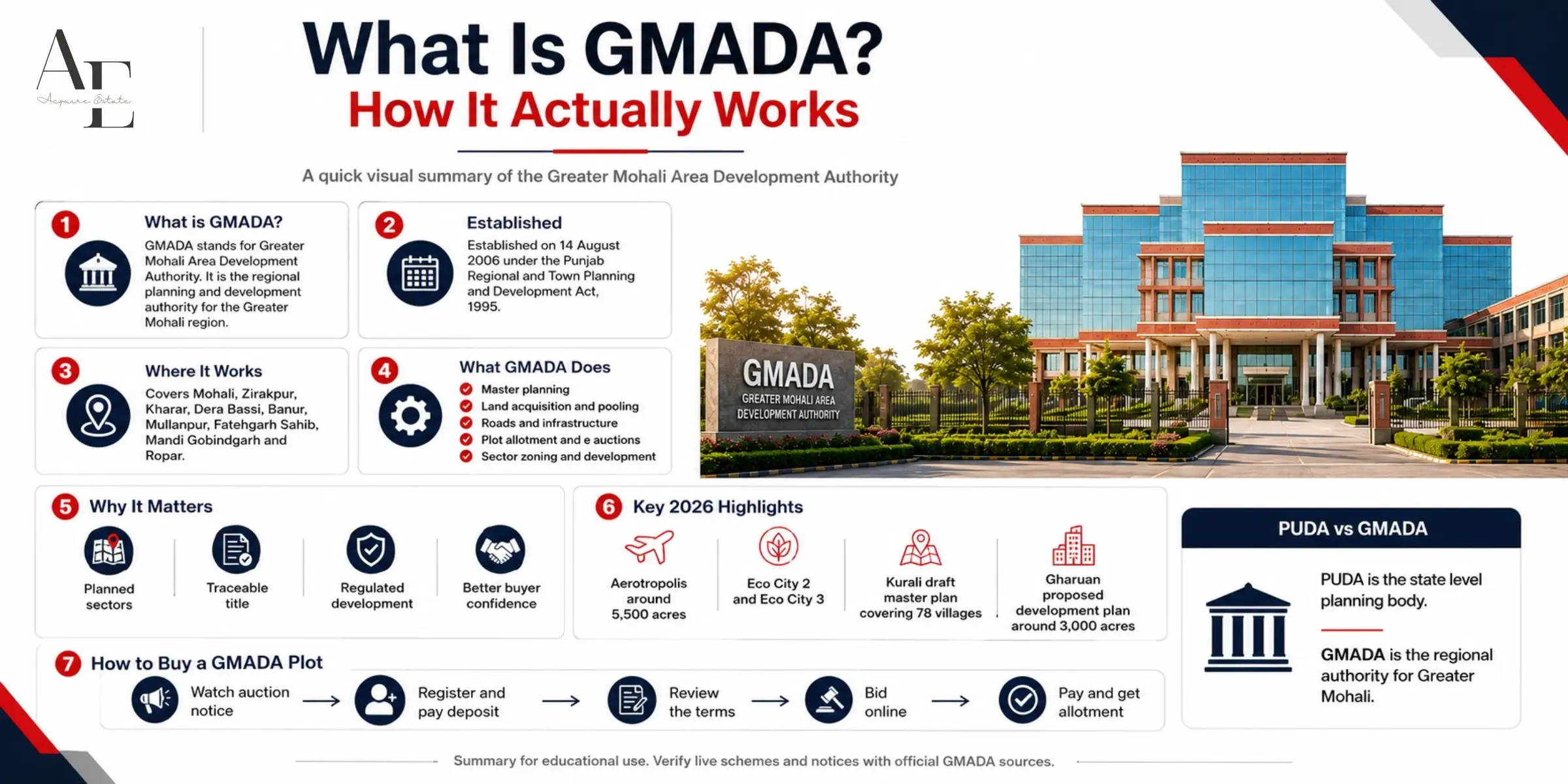
In the simplest terms, GMADA is the statutory planning and development authority responsible for the SAS Nagar district and the wider Greater Mohali region, which today stretches across Mohali, Banur, Zirakpur, Derabassi, Kharar, Mullanpur, Fatehgarh Sahib, Mandi Gobindgarh and Ropar.
Its job sounds almost mechanical on paper: acquire land, prepare master plans, build roads and sewerage and then allot plots to residents, builders and institutions. But the effect of that job is anything but mechanical. Every sector number, every wide avenue, every green belt that separates a residential pocket from an industrial zone in this region exists because GMADA planned it that way years, sometimes decades, in advance.
The Chief Minister of Punjab chairs the authority and day to day operations are handled by a Chief Administrator supported by three working committees: an executive committee, a planning and design committee and a budget and accounts scrutiny committee.
This structure means that no single official can quietly change a land use decision. Every major move, from acquiring a village's farmland to opening a fresh residential scheme, passes through layers of review before it becomes public. For a buyer, that layered process is exactly what should make you trust a GMADA plot more than an unauthorised colony where one developer's signature is the only safeguard you have.Read our detailed guide on RERA vs PUDA vs GMADA to understand the role each authority plays before purchasing a property.
Every township you admire today was once a protest, a delay or a scrapped plan
GMADA's story does not begin with a grand announcement. It begins with a law, the Punjab Regional and Town Planning Act, formally the Punjab Regional and Town Planning and Development Act of 1995, which gave the state government the power to create regional authorities wherever urban growth needed a firmer hand.
Under Section 29of that Act, the Punjab government issued notification number 13/52/2006-1HG2/7443 on 14 August 2006. With that single order, GMADA was born as one of the regional authorities working under the state's parent body, PUDA.
The authority did not start small either. In its early years, it commissioned Singapore's Jurong International to prepare a fifty year structure plan covering more than 1,200 square kilometres, imagining Dera Bassi as a manufacturing hub, Lalru as a service corridor and Mullanpur as a low density, nature focused residential belt, a vision that, two decades later, is finally taking shape in projects like New Chandigarh's Eco City townships.
The road since then has not been a straight line. GMADA has scrapped land acquisitions when farmers resisted, revived them years later under revised compensation terms — as seen most recently in the Sector 87 land acquisition — and faced court challenges over its authority to reshape village land into urban sectors.
In 2025, the Punjab and Haryana High Court upheld the constitutional validity of the Act that created GMADA and PUDA, closing a long running legal question about whether these bodies had overstepped their mandate.
That ruling matters to you as a buyer because it confirms, from the highest court with jurisdiction over Punjab, that a GMADA allotment stands on solid legal ground.
The safeguard nobody explains until something has already gone wrong
Buying land in India can be an emotional minefield and every family that has heard a horror story about a fraudulent registry or a colony without a legal water connection knows exactly why. GMADA's core value to a buyer is not glamour; it is certainty.
Because GMADA acquires land through a documented legal process and issues title through registered allotment letters, a plot bought through GMADA carries a traceable chain of ownership from the day the authority first acquired the land.
That is not a small thing in a market where private colonies sometimes sell the same plot to two different buyers or promise a road that never gets built.
GMADA develops internal infrastructure, roads, sewerage, water supply and electricity, alongside the allotment process and any lapse in that development, as seen in disputes over unfinished infrastructure in older sectors, can be challenged in court, with the Supreme Court in one instance directing the authority to fund overdue works. That accountability is the quiet safeguard separating a government authority from a private developer who can simply disappear.
One is the parent, one is the child and knowing the difference saves you from bad advice
Almost every buyer researching Mohali property runs into this confusion within the first five minutes, so let us settle it. PUDA, the Punjab Urban Planning and Development Authority, was established in July 1995 as the state's apex urban planning body, the umbrella organisation guiding balanced urban growth across the whole of Punjab.
On the other hand, GMADA is one of the regional development authorities created under PUDA's parent Act in 2006 and it works exclusively within the Greater Mohali region. Think of PUDA as the policy maker for the entire state, while GMADA is the implementer for one specific, fast growing corridor of Greater Mohali area.
Point of Difference | PUDA | GMADA |
Jurisdiction | Entire state of Punjab | Mohali, Zirakpur, Kharar, Derabassi, Banur, Mullanpur, Fatehgarh Sahib, Ropar |
Established | July 1995 | 14 August 2006 |
Role | Apex policy and coordinating body | Regional planning, land allotment and infrastructure delivery |
Typical Buyer Touchpoint | State level rules, colony licensing | Sector plots, e-auctions, land pooling schemes |
Why every GMADA notice you read quotes a section number
If you read a GMADA public notice closely, you will notice it almost always cites a section of the Punjab Regional and Town Planning Act. That habit is not bureaucratic decoration; it is the source of GMADA's authority.
The 1995 Act gives regional authorities the legal power to acquire land, prepare regional and master plans and enforce zoning, building on the older framework laid out in the Punjab Land Reforms Act 1972, meaning a residential zone cannot suddenly turn into an unauthorised industrial plot without a formally amended, publicly notified plan.
This is also why proposed changes, like the recent draft amendment introducing industrial and commercial zoning around Gharuan, go through a public objection window before they are finalised. Nothing changes overnight and that slowness is precisely what protects the value of the plot you already hold.
The farmer, the file and the formula that turns an acre into a plot
Most of GMADA's newer schemes, including Eco City 4 and Aerotropolis, are built on the GMADA land pooling scheme, a method where landowners are not paid cash for their fields but promised a proportion of developed plots once the township is ready.
Instead of the authority fighting years of litigation over compensation, landowners become stakeholders in the very township that replaces their farmland.
The ratio varies scheme by scheme. For Aerotropolis, landowners contributing 100 square yards of acquired land have been promised roughly 500 square yards in the developed township, while an earlier Eco City 3 formula set every acre pooled to return 1,100 square yards of residential plot and 200 square yards of commercial plot.
These numbers illustrate the scheme's structure; any buyer relying on land pooling ratios for a live transaction should verify the current figure directly with GMADA, since policy revisions do happen.
For an outside investor rather than the original landowner, this usually means buying a GMADA residential plot or GMADA commercial plot either directly from GMADA once fresh allotments open or from an original allottee in the secondary market, where a Letter of Intent changes hands before possession is even granted.
A township the size of a small town, rising beside an airport that is already breaking records
Ask any Mohali property dealer what is dominating conversations in 2026 and the answer will almost certainly be GMADA Aerocity and its far larger successor, GMADA Aerotropolis Mohali.
Spread across roughly 5,500 acres and divided into nine pockets labelled A through J, Aerotropolis sits beside the Shaheed Bhagat Singh International Airport, a location that alone explains why demand has stayed strong through construction delays.
The airport crossed 2.8 million passengers in 2025 to 2026 and now runs direct international routes to Canada, the UAE and the UK, which is why a meaningful share of Aerotropolis enquiries come from NRI buyers with a direct stake in this corridor.
Development has not been without friction, pockets B, C and D have moved ahead with grid road construction targeted for completion around April 2026.
Because fresh GMADA allotments in the active pockets have effectively closed now, most buyers today enter through the secondary market, purchasing a Letter of Intent from an original allottee rather than booking directly with the authority.
Approx. Rate per Sq. Yard | Note | |
Pocket A | Rs. 50,000 to 57,000 | Includes disputed acreage; verify title carefully |
Pocket B | Rs. 40,000 to 43,000 | Grid road works in progress |
Pocket C | Rs. 38,000 to 41,000 | Grid road works in progress |
Pocket D | Rs. 37,000 to 40,000 | Grid road works in progress |
These figures are dealer reported secondary market rates rather than official GMADA allotment prices and they move with every fresh land acquisition notice, so treat any number you see, including ours, as a starting point for your own verification rather than a final figure.
For the actual compensation figures behind this corridor, see our coverage of the record Rs 8.29 crore per acre payout.
A project that was cancelled once, revived twice and is finally moving
Few GMADA projects carry a more dramatic backstory than GMADA Eco City 3. First proposed to expand New Chandigarh's already successful Eco City 1 township, the scheme was scrapped in 2020 after the Covid lockdown crushed both GMADA's finances and landowner interest, with barely a quarter of the targeted 450 landowners agreeing to pool their land. The authority revived the plan, refined the compensation formula and by late 2025 had acquired around 716 acres across nine villages, backed by a compensation award reported in the thousands of crores.
What makes GMADA Eco City 2 / Eco City 3 genuinely different from Eco City 1 is scale and timing. Eco City 1 delivered strong appreciation over twelve to fifteen years for its early investors and Eco City 3, at nearly double the acreage with far more current infrastructure standards, saw tenders for sewerage, roads and stormwater drains expected to float in the first quarter of 2026. GMADA's own chief administrator has indicated that Eco City 2's extension and Eco City 3 may see a combined launch once infrastructure work is further along, so buyers eyeing this belt should watch official notices rather than informal launch dates circulating among agents.
The map GMADA just redrew and why it puts Kurali on every serious investor's radar
For most of its history, GMADA's jurisdiction map treated GMADA New Chandigarh as its showpiece expansion zone, home to Knowledge City, Medicity, Education City and the Eco City townships.
In July 2026, that map grew again. GMADA released a draft regional master plan Kurali, covering 78 villages, the first time Kurali has been treated as a planning area in its own right rather than an afterthought folded into an older 2009 exercise.
Town planning experts have flagged real concerns about the draft, including gaps in residential continuity between the Kurali and Gharuan plans and inconsistent commercial zoning along the Kharar Kurali highway, concerns significant enough that any buyer should treat this as a draft under objection rather than a finalised blueprint.
Running alongside it is the GMADA Gharuan development plan, a proposed amendment covering close to 3,000 acres across sixteen villages near Gharuan, designating some villages for industrial and commercial use and others for residential development, largely because of Gharuan's proximity to established institutions like IISER and the Indian School of Business.
Both plans remain in the public objection stage as of mid-2026, so the window to understand and respond to them is open right now, not months from now.
While the new sectors make headlines, these three towns quietly keep the market moving
It is easy to get swept up in the excitement of Aerotropolis and Eco City 3, but GMADA Zirakpur, Kharar and Derabassi projects remain the backbone of everyday transactions here. Zirakpur benefits from its position as the gateway between Chandigarh, Panchkula and Mohali, Kharar has grown around its educational institutions.
Additionally, its proximity to the highway now central to the new master plan and Derabassi continues to attract buyers priced out of central Mohali who still want a GMADA backed, legally traceable plot rather than an unauthorised colony. These are not the flashiest names in GMADA's portfolio, but for a family working with a realistic budget, they are often the more sensible entry point.
The two words hiding in your allotment letter that decide how freely you can sell later
Most residential plots allotted by GMADA are freehold, meaning ownership transfers fully to the buyer once dues are cleared and the conveyance deed is registered, giving the owner the right to sell, mortgage or transfer the property without seeking the authority's permission each time.
Certain institutional and large scale allotments, particularly some parcels reserved for universities and select commercial uses, have historically been offered on a leasehold or leasehold cum freehold basis, where GMADA retains a longer term interest and the buyer's rights around subdivision or change of use remain more restricted.
Before finalising any purchase, confirm in writing whether your specific plot carries freehold or leasehold status, because that single detail affects everything from bank loan eligibility to how easily you can sell the property a decade from now.
No agent, no middleman, just you, a login and a bid
One of GMADA's genuine strengths is that it sells a meaningful share of its inventory, residential, commercial, chunk and institutional sites, through a transparent e-auction system rather than word of mouth allocation. Here is how the process unfolds for a first time bidder.
Watch the official GMADA website regularly under its e-Auction section for fresh auction notices, since new sites are announced there before anywhere else.
Register on the e-auction portal and pay the prescribed earnest money or eligibility deposit for the specific site you intend to bid on.
Study the site's terms and conditions carefully, including reserve price, payment schedule and any use restrictions, before the bidding window opens.
Place your bid online within the auction window; the process is fully digital, which removes the scope for an intermediary to manipulate the outcome.
If you emerge as the highest bidder, your bid goes to the Chief Administrator for review and approval, after which you receive an intimation letter confirming provisional allotment.
Pay 25 percent of the total bid amount within the specified deadline, with the remaining 75 percent payable either as a lump sum or in structured instalments.
Once payment terms are met, GMADA issues the formal allotment letter and possession follows after any final compliance checks are cleared.
A word of caution built into the system itself: bidders who withdraw after their bid is accepted forfeit their eligibility fee and developers with more than two unpaid instalments on any earlier GMADA property are barred from participating again, a rule that quietly protects genuine buyers from being outbid by financially unreliable players.
Why a plot's sector number tells you more than its price tag ever will
Understanding Mohali sector-wise plots matters because GMADA's zoning gives each sector a specific character, some purely residential, others mixed use, a few institutional or industrial, so two plots that look identical on paper can carry very different long term value depending on what surrounds them.
This sector discipline is part of what makes Tricity real estate, spanning Chandigarh, Mohali and Panchkula, feel more organised than many comparable urban clusters elsewhere in North India, a discipline that traces directly back to urban planning Mohali decisions GMADA made years, sometimes decades, before a single plot went up for sale.
GMADA will not make every decision quickly and it will not always get every draft plan right the first time, as the objections raised over the Kurali master plan remind us. But for anyone weighing a plot in this region, GMADA remains the closest thing to a guarantee that the sector you buy into today will still have working roads, sewerage and a clean title a decade from now. That is the quiet promise behind every notification, every e-auction and every land pooling form the Greater Mohali Area Development Authority issues. Before you sign anything, verify the scheme status directly with GMADA and remember that the family who waited patiently for their sector to develop almost always ends up better off than the one who rushed into an unauthorised shortcut.
GMADA is the Greater Mohali Area Development Authority, formed in 2006 under the Punjab Regional and Town Planning Act to plan, acquire land for and develop the Greater Mohali region, allotting plots through schemes, land pooling and e-auctions.
PUDA is Punjab's apex urban planning authority for the whole state, while GMADA is one of PUDA's regional authorities working exclusively within the Mohali, Zirakpur, Kharar, Derabassi and New Chandigarh belt.
You can bid on a fresh plot through GMADA's official e-auction portal after registering and paying the eligibility deposit or buy an existing allotment from a registered owner in the secondary market with a verified transfer.
The most active 2026 schemes include Aerotropolis Mohali, the revived Eco City 3 project in New Chandigarh and the draft master plans for Kurali and Gharuan, all at different stages of acquisition or public objection.
Aerotropolis spans roughly 5,500 acres divided into nine pockets near Shaheed Bhagat Singh International Airport, with Pockets A through D in active development and Pocket A partly under a pending court dispute.
GMADA released a draft regional master plan for Kurali covering 78 villages in July 2026, alongside a proposed amendment introducing industrial, commercial and residential zoning across roughly 3,000 acres near Gharuan, both still open to public objections.
It involves registering on the portal, paying the eligibility deposit, reviewing site terms, placing your bid, receiving an intimation letter if you win, paying 25 percent of the bid amount followed by the balance and finally getting the allotment letter and possession.
GB Realty has officially taken over the Downtown Mohali commercial project in Sector 62, bringing RERA-approved shops, s...
Ecocity GMADA is New Chandigarh's flagship plotted township, developed by the Greater Mohali Area Development Authority....
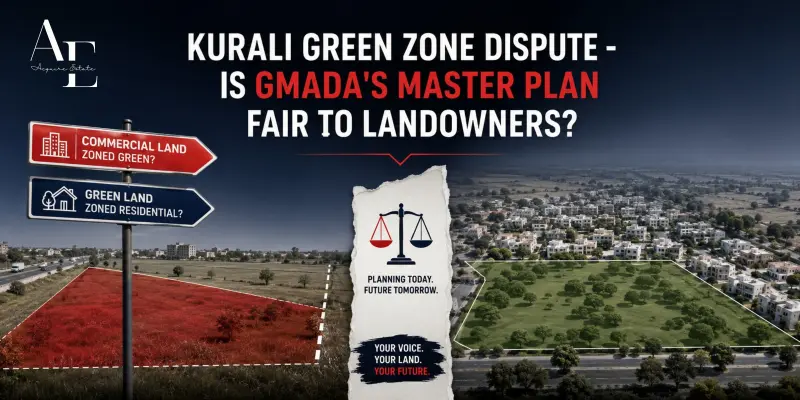
A quiet notification has turned into one of Mohali's loudest land disputes this year. Across 78 villages near Kurali, fa...