


GMADA & Infrastructure News
GB Realty Acquire Downtown Mohali For Which Everyone Is Talking About
GB Realty has officially taken over the Downtown Mohali commercial project in Sector 62, bringing RERA-approved shops, s...
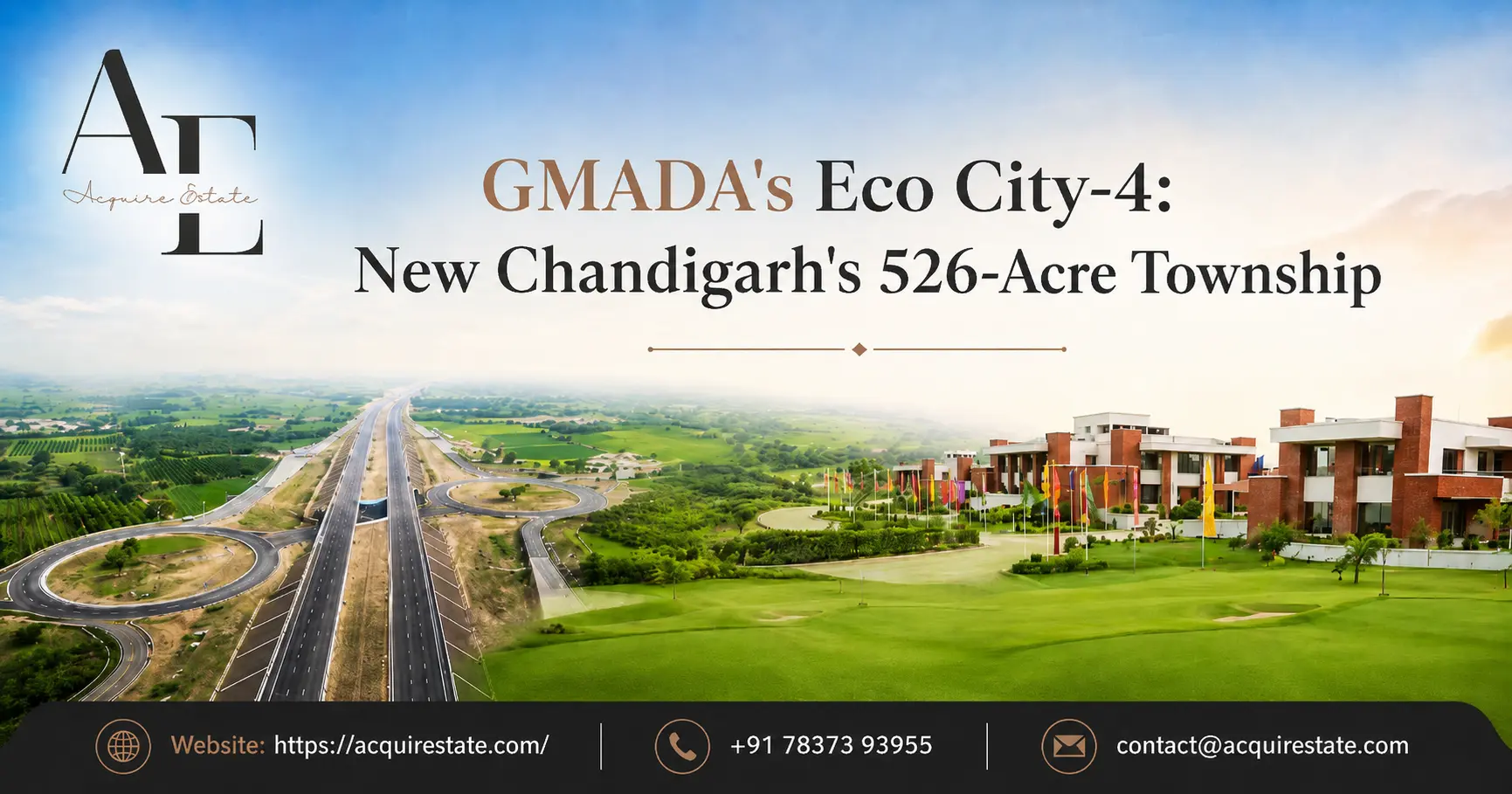
Punjab launches Eco City-4 in New Chandigarh - 526 acres acquired while Eco City-3 is still pending. What it means for investors…Punjab launches Eco City-4 in New Chandigarh - 526 acres acquired while Eco City-3 is still pending. What it means for investors in 2026.






You filled out a form. You waited. And then — if you were one of the lucky few — your name came up in a draw among 4,50,000 applicants competing for just 836 plots.
Those who got in? They're sitting on some of the most valuable government-allotted land near Chandigarh today.Now fast-forward to 2026. The Punjab government has just initiated land acquisition for Eco City-4 — over 526 acres of fresh residential township in New Chandigarh.
Here's the twist that nobody saw coming:
Eco City-3 hasn't even started development for residents yet. The land was only acquired in December 2025. The infrastructure tenders are just being floated. And yet, the state has already moved on to planning the next township.
Why would a government jump to Phase 4 before Phase 3 is even off the ground?
That question has a very interesting answer — and it tells you a lot about where New Chandigarh's real estate market is headed.Whether you are a first-time homebuyer, a seasoned plot investor, or just someone who has been watching Tricity real estate with one eye open — this is the article you need to read today.
Let's get into it.
To understand Eco City-4, you first need to understand the full picture of what Punjab is building.
In one of the most ambitious urban expansion drives in the state's history, the Punjab government — through its planning body GMADA (Greater Mohali Area Development Authority)— has set in motion the compulsory acquisition of over 11,103 acres across Greater Mohali and New Chandigarh. The plan includes seven new townships, seven new sectors, three new pockets of Aerotropolis, and a new commercial city centre in Sector 87, Mohali.
Eco City-4 is part of this larger vision.
The Punjab government has initiated the land acquisition process for more than 526 acres of land in New Chandigarh (Mullanpur area, SAS Nagar district) to develop a new residential township. This is being planned under the framework of the Right to Fair Compensation and Transparency in Land Acquisition, Rehabilitation and Resettlement Act, 2013.
The big story? This is happening even while Eco City-3's development work has not yet started on the ground for residents — and Eco City-2 was still relatively fresh when Eco City-3 was announced.
If you are new to New Chandigarh's real estate story, here is a fast recap:
Eco City-3 is the big one currently in the news. GMADA acquired 716 acres from nine villages — Kansala, Kartarpur, Rajgarh, Takipur, Hoshiarpur, Rasulpur, Dhodemajra, Majra, and Salamatpur. The total compensation announced was a staggering ₹3,690 crore, with rates touching ₹6.46 crore per acre in some villages. The Land Acquisition Collector officially cleared possession under Section 19 of the Land Acquisition Act, 2013. GMADA's Chief Administrator has indicated that the township launch could happen by end of 2026
And now, Eco City-4 — 526+ acres — is already in the pipelin
| Township | Area | Current Status | Residential Plots |
|---|---|---|---|
| Eco City-1 | ~419 Acres | Fully developed and inhabited township | 2,759 |
| Eco City-2 | ~387 Acres | Developed with plots already allotted | 1,364 |
| Eco City-3 | 716 Acres | Land acquired; launch anticipated in 2026 | TBA |
| Eco City-4 | 526+ Acres | Land acquisition process underway | TBA |
This is an important question — especially for farmers and landowners in the area.
The Punjab government earlier attempted a Land Pooling Policy in early 2025, under which farmers would receive developed plots instead of cash. This model triggered widespread farmer protests across the affected villages, and the Punjab and Haryana High Court issued an interim stay. The government withdrew the policy entirely in August 2025.
In November 2025, a revised Land Pooling Policy was notified — but this time it was made entirely optional for farmers.
Under the current framework, landowners now have a choice:
Compensation for trees, structures, and houses on acquired land
The government has described this new arrangement as "heavily loaded in farmers' favour" — senior officials told The Tribune that average land values in the GMADA belt rose from approximately ₹5 crore per acre (pre-acquisition notifications) to around ₹8 crore per acre after the notifications were issued.
New Chandigarh (Mullanpur) is not just another suburb. It is a master-planned township designed to serve as a counter-magnet to Chandigarh city — reducing the pressure on the Union Territory's strained infrastructure while offering high-quality planned living.
Here is what makes this area special:
Location: Situated at the foothills of the Shivalik Hills, about 6 km from Chandigarh's Madhya Marg via a 200-foot-wide, six-lane road.
Planned infrastructure: GMADA has already built or is developing Education City, Medi City, IT zones, and residential eco-townships in the region. The area has provisions for metro connectivity in the future.
Low density living: New Chandigarh is designed for low population density — an approach that keeps the environment intact and living quality high, compared to the congestion seen in older Chandigarh areas.
Real estate appreciation: Land values in the GMADA area have already risen sharply — from ~₹5 crore per acre to ~₹8 crore per acre in a short period — following acquisition notifications alone. This shows the level of market confidence in the area.
As Chief Minister Bhagwant Mann put it: "The day is not far when Chandigarh will look at Mohali and New Chandigarh with envy, not the other way around. This is not just land acquisition — this is Punjab's urban renaissance.
Let us be honest with you: Eco City-4 is early-stage right now. The land acquisition process has been initiated, but there is a long road to allotment of plots.
However, here is what investors watching this space should understand:
1. Early Mover Advantage Is Real in New Chandigarh
Eco City-1 was oversubscribed 190× — that is not a typo. 4,50,000 people applied for 836 plots. When GMADA launches a township in this region, demand is always enormous. Getting on a waiting list or monitoring announcements closely can make a significant difference.
2. GMADA Plots Come with Strong Legal Standing
One of the core advantages of GMADA-developed plots is security. These are government-planned, government-acquired, and government-sold. There are no builder defaults, no RERA violations to chase, no shady floor space index issues. What you buy is what you get.
3. The Phased Development Signal Is Positive
The fact that the government is planning Eco City-4 even before Eco City-3 launches is a strong signal of commitment to New Chandigarh's long-term development. A pipeline this large does not get built without serious infrastructure intent behind it.
4. Infrastructure Is Following the Land
The state has committed to acquiring 1,240 acres just for master plan roads across Mohali and New Chandigarh. Roads, sewerage, stormwater drains, water supply — all of this is being factored into the acquisition plan. This is not speculative development; it is planned, statutory urban growth.
This is the real question most buyers have.
If you want a GMADA plot in New Chandigarh right now, you need to monitor announcements from GMADA's official websiteclosely. Eco City-3 allotments are expected to be announced by end of 2026. Eco City-4 will take longer.
If you are looking for a home or apartment in New Chandigarh today, there are private developments in the area that you can evaluate right now. One well-researched option isThe Tiara New Chandigarh — a luxury high-rise in the Medicity area developed by the Sham Exotic Group. It is designed for those who want large, premium apartments (4 BHK from 4,100 sq ft) in a planned township location.
If you are comparing New Chandigarh vs Mohali, the story is different for each buyer type. New Chandigarh suits those who want lower density, planned government plots, and long-term appreciation. Mohali suits those who want quicker possession and established social infrastructure. Our detailed guide on buying a flat in Mohali in 2026 covers the differences well.
For those interested in the broader GMADA investment story, read our detailed breakdown of GMADA land acquisition in Mohali 2026— it covers prices, growth zones, and what to expect from returns.
Key Challenges to Watch
No real estate story is complete without acknowledging the risks. Here are the ones worth watching for Eco City-4:
Farmer Protests: Farmers from villages affected by the acquisition drive have launched a sustained protest — called a "Pucca Morcha" — outside GMADA headquarters in Mohali. The movement is backed by Congress, SAD, and BJP.
While government officials have cited village panchayat resolutions endorsing the acquisition, unresolved farmer grievances could cause delays.
Legal Challenges: Earlier, the Punjab and Haryana High Court stayed the previous land pooling policy. While that specific policy has been withdrawn, legal challenges related to land valuation or acquisition process from individual landowners are always possible.
Development Lag: Eco City-3 itself was first announced in 2016, faced delays in 2020 due to budget constraints and the pandemic, and is only now moving toward a launch in late 2026. Eco City-4, being newer, is likely to have a longer runway. Do not expect plots in Eco City-4 before 2027–2028 at the earliest.
Environmental Sensitivity: The Mullanpur-New Chandigarh region lies near the Shivalik eco-zone. Some of the planned townships in the area require environmental clearances from the Ministry of Environment, Forest and Climate Change (MoEF). Any delay in clearances can affect timelines.
Eco City-4 is a planned residential township by the Punjab government in New Chandigarh (Mullanpur area). The state has initiated the acquisition of more than 526 acres for this project, even as the adjacent Eco City-3 is still in the pre-launch infrastructure phase.
GMADA prices are typically set based on the cost of land acquisition, development, and infrastructure — not market speculation. Eco City-1 and 2 were competitively priced, with prices for plots varying by size (100 to 500 sq yards and above). Eco City-3 and 4 prices will be announced closer to launch.
Not directly. GMADA does not accept pre-launch bookings for its schemes. When the allotment scheme opens, you apply through the official GMADA process.
GMADA Eco City plots are typically available in sizes of 100, 150, 200, 300, 400, 500 sq yards, and larger 1 and 2 Kanal plots. Exact sizes for Eco City-4 will be announced at the time of the scheme launch.
The revised November 2025 Land Pooling Policy is optional. Farmers can choose between cash compensation (calculated at base market value × 1.5 + 100% solatium + 12% interest) or land pooling (residential and commercial plots in lieu of land). Senior officials have described this as heavily weighted in farmers' favour.
This is the question every smart buyer should ask — and the honest answer is: relatively safe, but with conditions you must understand.
GB Realty has officially taken over the Downtown Mohali commercial project in Sector 62, bringing RERA-approved shops, s...
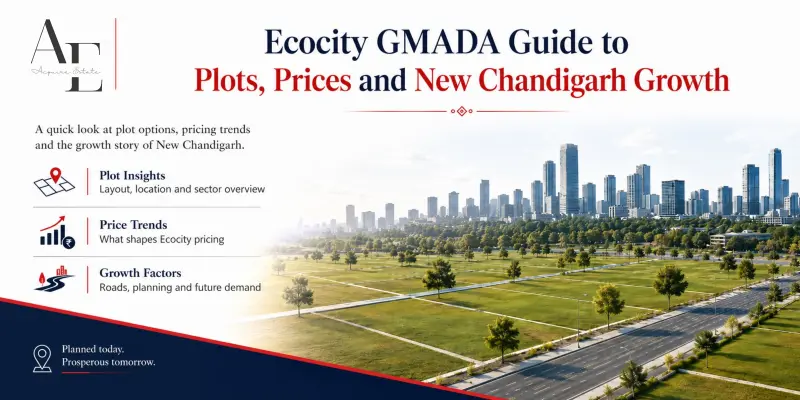
Ecocity GMADA is New Chandigarh's flagship plotted township, developed by the Greater Mohali Area Development Authority....
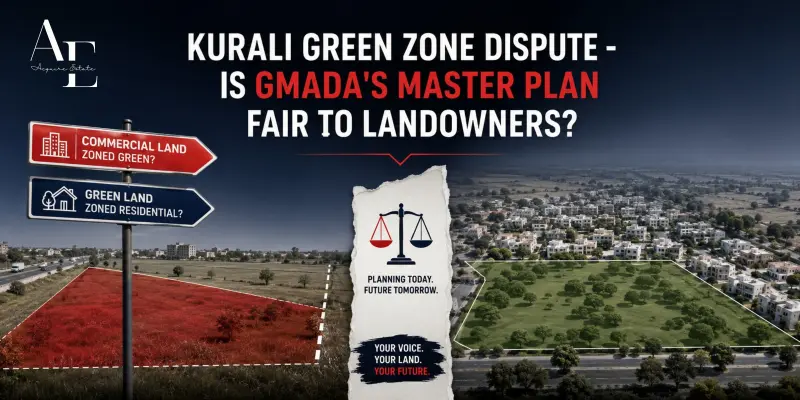
A quiet notification has turned into one of Mohali's loudest land disputes this year. Across 78 villages near Kurali, fa...