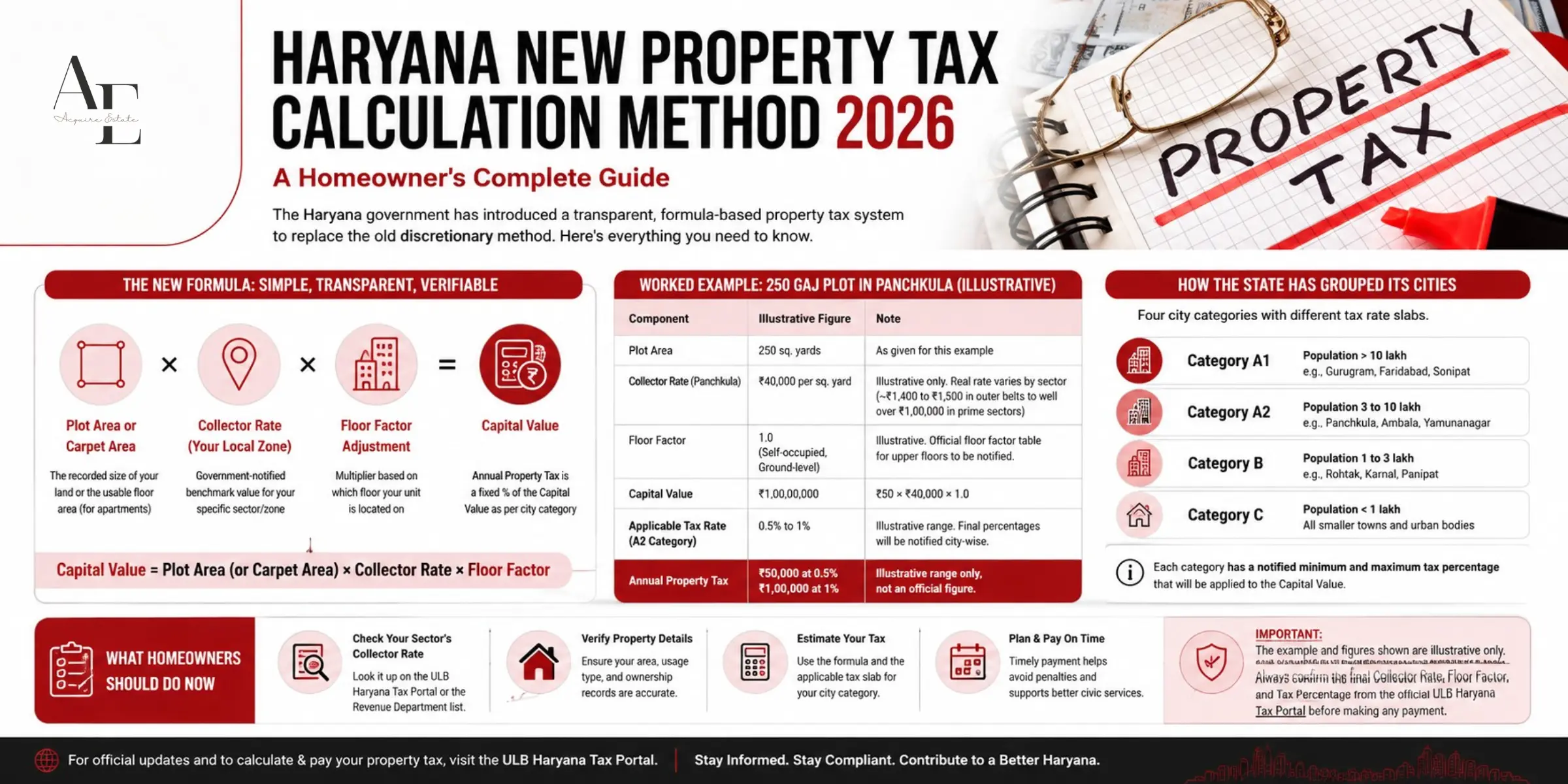
Haryana has retired its 2013 property tax rules and adopted a fresh, formula-based system built around Capital Value, Collector Rate and a…Haryana has retired its 2013 property tax rules and adopted a fresh, formula-based system built around Capital Value, Collector Rate and a Floor Factor. This piece walks through the Haryana New Property Tax Calculation Method, works out a real-world 250 Gaj Panchkula example, lists the new rebates, exemptions and safeguards and tells you exactly what to check before your next tax cycle begins.
Somewhere in a Panchkula municipal office right now, a clerk is punching numbers into a system that looks nothing like the one your father dealt with a decade ago. That change is not a small administrative tweak. It is the Haryana New Property Tax Calculation Methodand it decides what every homeowner from Ambala to Gurugram pays from the next assessment cycle onward.
For over a decade, Haryana's house tax bills were worked out under rules notified in 2013, rules that left far too much room for individual judgment. Two neighbours with near-identical plots could end up with two very different bills and almost nobody could explain why.
The Haryana Cabinet, under Chief Minister Nayab Singh Saini, has now given in-principle approval to a Capital Value Formula Haryanaresidents can actually verify for themselves. If you own property anywhere in the state or are planning to, this guide breaks down exactly how the new Haryana Municipal Property Tax 2026system works, what a real plot in Panchkulawould cost under it and what you should be doing this month.
A Quick Recap: Why the Old Assessment System Had to Go
Property tax in Haryana used to be calculated under notifications dating back to 2013 and those notifications leaned heavily on discretionary assessment. Officials weighed a mix of factors that were not applied uniformly from file to file, so identical properties on the same street could carry different tax burdens depending purely on who reviewed the paperwork.
That inconsistency built up years of disputes, delayed payments and objections piling up at municipal counters. The state government has now moved to close that gap.
The new rules are notified separately for Municipal Corporations under the Haryana Municipal Corporation Act, 1994 and for Municipal Councils and Committees under the Haryana Municipal Act, 1973 and they formally supersede the 2013 notifications across every Urban Local Body in the state.
Breaking Down the Capital Value Formula Haryana Has Adopted
The core idea behind the Haryana New Property Tax Calculation Method is simple: replace an official's judgment call with a formula anyone can run themselves. Every property's Capital Value is now built from three visible inputs and a prescribed percentage, fixed by the city's category, is applied to that Capital Value to arrive at the final tax.
Formula Component
What It Actually Measures
Plot Area or Carpet Area
The recorded size of your land or the usable floor area of your unit if you own a flat.
Collector Rate Panchkula(or your local zone)
The government-notified benchmark value for land or built-up property in your specific sector, the same figure already used for stamp duty.
Floor Factor Property Taxadjustment
A multiplier that reflects which floor a unit sits on, since ground-floor and upper-floor spaces are not valued the same way.
Combine the three and the equation reads: Capital Value = Plot Area (or Carpet Area) × Collector Rate × Floor Factor. Your annual property tax is then a fixed percentage of this Capital Value and that percentage is set by which of the four city categories your Urban Local Body falls into. Anyone can now look up the notified Collector Rate for their own zone instead of waiting for an assessor to arrive at a number behind closed doors.
Worked Example: What Would a 250 Gaj Plot in Panchkula Actually Cost?
Numbers land better than theory, so let's run an illustrative calculation for a 250 Gaj residential plot/ Projects in PanchkulaOne Gaj equals one square yard, so this is a 250 square yard plot, a fairly common size across Panchkula's residential sectors.
Component
Illustrative Figure
Plot Area
250 sq. yards
Collector Rate Panchkula
₹40,000 per sq. yard
Floor Factor
1.0 (self-occupied, ground-level residential)
Capital Value
250 × ₹40,000 × 1.0 = ₹1,00,00,000
Applicable tax rate (A2 category, illustrative)
0.5% to 1%
Annual Property Tax
₹50,000 at 0.5% or ₹1,00,000 at 1%
This example exists to show you how the arithmetic works, not to predict your actual bill. Two things in that table, the Collector Rate and the tax percentage, are sector-specific and city-specific and both must be confirmed on the official ULB Haryana Tax Portalbefore you rely on any number for payment planning.
How the State Has Grouped Its Cities
Not every Urban Local Body carries the same civic budget or infrastructure load, so a flat rate across the whole state was never going to be fair. The new system sorts every city into one of four categories, each with its own floor and ceiling tax rate, giving municipalities room to fix local rates within that band.
Category
Applies To
Governing Law
A1
Larger Municipal Corporations
Haryana Municipal Corporation Act, 1994
A2
Other Municipal Corporations
Haryana Municipal Corporation Act, 1994
B
Municipal Councils
Haryana Municipal Act, 1973
C
Municipal Committees
Haryana Municipal Act, 1973
The exact floor and ceiling percentages for each category are being rolled out city by city, so a Panchkula homeowner and a Gurugram homeowner in the same category will still need to check their own municipality's final notified rate rather than assuming a shared number.
New Rebates Worth Knowing About
Alongside the formula change, the state has also introduced a set of rebates that did not exist under the 2013 rules. Residential properties within the Lal Dora of newly included villages get relief for five years from the date of inclusion in municipal limits, covering up to three floors, while residential properties within the Lal Dora of already-existing villages inside municipal limits get a standing 75 percent rebate on property tax.
Beyond that, the policy adds targeted relief: a rebate for owners who clear all dues, including arrears, by April 30 of the assessment year; a further rebate for taxpayers who have paid on time for three consecutive years; a rebate for residential properties owned by women; a rebate for residential properties owned by persons with 40 percent or more disability; and a rebate for group housing societies or property clusters running a fully functional zero-waste management system.
Reports describe these as subject to an overall combined cap per property, so if more than one applies to your household, confirm the exact stacking rules with your local ULB office rather than adding the percentages yourself.
Will Your Bill Jump Overnight?
This is usually the first worry homeowners raise and it is a reasonable one to have. The government has built in a cushion. Any increase in tax liability under the new system is capped and phased in gradually rather than applied as one lump revision.
Property owners who have already cleared their dues will see no impact from the new methodology until Financial Year 2026-27 and arrears or interest relating to Financial Year 2025-26 and earlier stay untouched by this change. The transition is designed to be gradual, not a sudden jolt to a household's monthly budget.
Who Does Not Have to Pay at All
The policy also carves out a fairly wide exemption list, recognising that not every structure in a city is meant to generate revenue. It's worth checking whether your property or one you manage on behalf of family, falls into any of these buckets:
Religious properties, such as temples, gurudwaras, churches and mosques, that provide public services free of cost
Municipal properties that are not leased or rented out to anyone
Orphanages, almshouses, dharamshalas, cremation grounds and burial grounds
Government-run educational institutions and government hospitals
Land used exclusively for agricultural purposes
Gaushalas, provided any commercial activity stays limited to milk, dairy products or ganic fertilisers, Bio-CNG, biogas, cow dung or cow urine
Self-occupied residential houses up to 250 square metres owned by serving or ex-servicemen, paramilitary personnel or the families of deceased soldiers
What Should You Actually Do This Month?
None of this calls for panic, but it does call for a little homework. Here is a practical checklist worth working through before your next assessment cycle:
Log into the ULB Haryana Tax Portaland confirm your property's recorded plot area or carpet area matches your registry documents
Check whether the collector rate for your specific sector has been revised recently, since several NCR-adjacent districts saw upward revisions heading into FY 2025-26
Keep your registry papers, most recent tax receipt and any exemption paperwork, such as ex-servicemen certificates, within easy reach
If you believe a rebate or exemption applies to you, raise it with your local ULB office proactively instead of waiting for a fresh demand notice
Track the official, city-wise notification for your category's tax rate, since cabinet approval is only the first step before local rollout
The Bigger Picture
A change to something as personal as your house tax bill can feel unsettling, particularly when it touches a home you spent years working towards. But at its core, the Haryana New Property Tax Calculation Methodis an attempt to trade an opaque process for a transparent one. It swaps discretionary assessment for a formula built on plot area, collector rate and floor factor, so any homeowner can eventually check their own bill instead of trusting a number they never saw calculated.
With a phased rollout, a cap on sudden increases, protection for dues already paid and a fresh set of rebates layered on top, this system has clearly been built with actual households in mind. The best thing you can do now is verify your own property details on the official portal and make sure this new formula works in your favour, not against you.
Looking to Buy, Sell or Rent in the Tricity Region?
Acquire Estatehas spent over a decade helping families across Chandigarh, Mohali, Zirakpur, Panchkula and Kharar find verified homes with transparent, no-surprises paperwork. Whether you are buying your first flat or evaluating a plot before this new tax formula rolls out fully, our team can walk you through the numbers before you sign anything. Call us at 7837393955 to get started.
Frequently Asked Questions
1. What exactly is the Haryana New Property Tax Calculation Method?
It is a formula-based system that calculates a property's Capital Value by multiplying Plot Area or Carpet Area by the notified Collector Rate and a Floor Factor, then applies a fixed percentage based on the city's category to arrive at the annual tax.
2. How is capital value calculated for Haryana property tax?
Capital Value equals Plot Area or Carpet Area multiplied by the applicable Collector Rate for that zone, multiplied again by the Floor Factor for the unit's floor level. The same equation applies statewide, which is what makes it verifiable.
3. When does the new system actually take effect?
The Haryana Cabinet has given in-principle approval and the new methodology supersedes the 2013 notifications. Dues already paid stay unaffected until Financial Year 2026-27, giving homeowners a transition window.
4. Could my tax bill double overnight under this system?
No. The government has capped how much tax liability can rise in one go and is phasing in the increase gradually, specifically to prevent sudden bill shocks for existing homeowners.
5. What are the four city categories under this system?
Cities fall into A1 and A2 for Municipal Corporations and B and C for Municipal Councils and Committees, each with its own floor and ceiling tax percentage set locally within state-prescribed limits.
6. Is there a Haryana property tax rebate for women owners?
Yes, residential properties owned by women are eligible for a rebate under the new policy, alongside separate rebates for persons with disabilities, group housing societies with waste management systems and owners who clear dues early.
7. Does this affect property tax dues I have already paid?
No. Arrears and interest relating to Financial Year 2025-26 and earlier remain unaffected and previously settled dues will not be revised under the new methodology.
8. Is there a Haryana ex-servicemen property tax exemption in 2026?
Yes. Self-occupied residential houses up to 250 square metres owned by serving or ex-servicemen, paramilitary personnel or families of deceased soldiers are exempt from property tax under the new policy.
9. How do I check the Collector Rate for my sector?
Collector rates are notified by the Haryana Revenue and Disaster Management Department for each zone and can be checked through your local tehsil office or the state's property registration portal.
10. Where can I pay my property tax online in Haryana?
Property tax across Haryana's Urban Local Bodies can be assessed and paid through the official ULB Haryana portal at property.ulbharyana.gov.in, where you can search using your Property ID, owner name or address.