


GMADA & Infrastructure News
GB Realty Acquire Downtown Mohali For Which Everyone Is Talking About
GB Realty has officially taken over the Downtown Mohali commercial project in Sector 62, bringing RERA-approved shops, s...
On July 21, 2026, GMADA announced Rs 23,457.74 crore in compensation across 3,522.98 acres in eight villages for the Aerotropolis project, topping…On July 21, 2026, GMADA announced Rs 23,457.74 crore in compensation across 3,522.98 acres in eight villages for the Aerotropolis project, topping out at a record Rs 8.29 crore per acre in Matran. Here is the full village-wise breakdown, what changed under Land Pooling Policy 3.0, and what it means for landowners, homebuyers and investors.







For decades, a farmer on the outskirts of Mohali went to sleep with one quiet worry: would the government ever pay a fair price for land his family had ploughed for generations?
That worry finally has an answer. On July 21, 2026, the Punjab Government stunned landowners and investors alike by clearing the highest-ever land compensation in the state's history under the GMADA Land Pooling Scheme 2026, a staggering Rs 8.29 crore per acre. This is not just another notification buried in a government file.
It is proof that the GMADA Land Pooling Scheme 2026 is genuinely changing how the state deals with the people whose land builds its cities.
Whether you are a farmer weighing your options, an investor tracking Mohali's growth story or a homebuyer curious about what is coming next, understanding the GMADA Land Pooling Scheme 2026 has never mattered more.
Stay ahead in real estate with Acquire Estate. We’re always ready to deliver the latest market news, emerging opportunities, expert insights, and timely updates. Whether you’re buying, investing, or expanding your portfolio, trust us to keep you informed and empowered every step of the way.
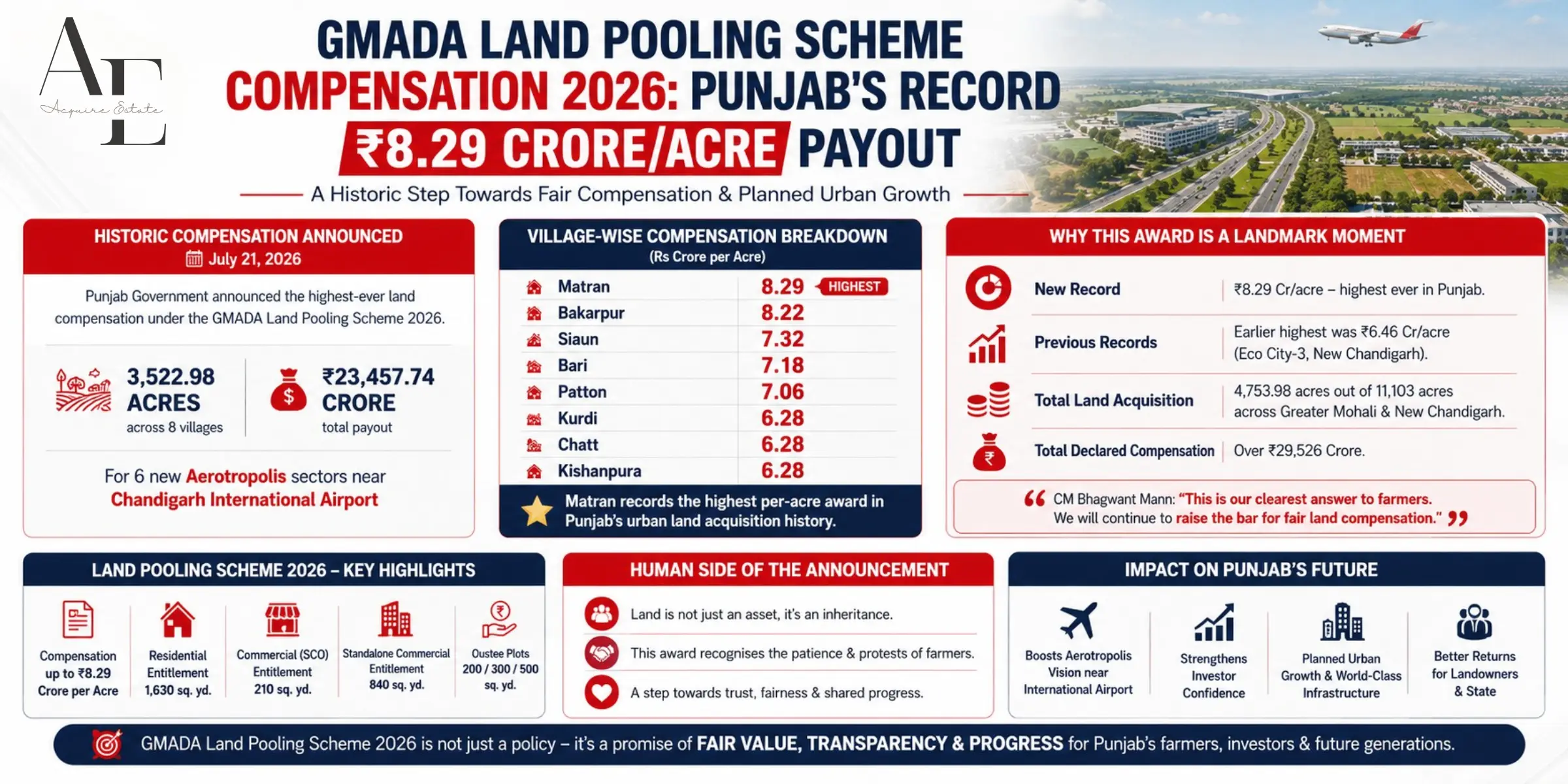
The Land Acquisition Collector for Mohali announced compensation awards for 3,522.98 acres spread across eight villages, all earmarked for six new Aerotropolis sectors near Chandigarh International Airport.
The total payout comes to Rs 23,457.74 crore as per The Tribune, the largest single-day land compensation announcement Punjab has ever recorded, both in scale and in value. The award was announced at the GMADA office in Mohali in the presence of the affected farmers and officials confirmed it as the highest per-acre rate the state has ever offered for urban development land.
Chief Minister Mr. Bhagwant Mann described the award as the government's clearest answer yet to farmers who have long questioned whether their land would ever be valued fairly, calling the payout proof that Punjab intends to keep raising the bar for landowners.
The compensation was not flat across all eight villages. It varied based on location, connectivity and proximity to the airport and IT City belt.
Village | Compensation (Rs Crore per Acre) |
Matran | 8.29 |
Bakarpur | 8.22 |
Siaun | 7.32 |
Bari | 7.18 |
Patton | 7.06 |
Kurdi | 6.28 |
Chatt | 6.28 |
Kishanpura | 6.28 |
Matran recorded the single highest per-acre award in Punjab's urban land acquisition history, edging past Bakarpur by a slim margin, while the three villages closest to the existing Aerocity belt settled at the base rate of Rs 6.28 crore per acre.
Context makes this number even more remarkable.
Before July 21, the previous record stood at Rs 6.46 crore per acre for Eco City-3 in New Chandigarh , followed by Rs 6.24 crore per acre for the Low Density and High Density township, also in New Chandigarh. Monday's award alone is worth nearly four times the combined value of the three previous awards put together.
With this announcement, Punjab has now declared compensation covering 4,753.98 acres out of an ongoing 11,103-acre acquisition driveacross Greater Mohali and New Chandigarh, pushing total declared compensation past Rs 29,526 crore. That is not a small policy tweak. That is a state fundamentally resetting what fair compensation looks like.
Numbers on a notification rarely capture what land actually means to a family. For many of the landowners in Kurdi, Matran or Bakarpur, this soil was an inheritance before it was an asset, the place where three generations grew wheat and raised children before anyone spoke of airports or sectors.
The compensation award does not erase the emotional weight of watching farmland turn into a city, but it does something equally important: it tells landowners that their patience and their protests were heard.
Farmers who spent weeks camped outside GMADA's office in earlier disputes are now seeing figures that, for the first time, feel proportional to what they are giving up.
This moment did not arrive quietly. Greater Mohali has seen a year of farmer agitation over compensation delays, valuation disputes and plot allotment timelines, including a prolonged dharna outside GMADAheadquarters that pushed the government back to the negotiating table.
The July 6 notification, often referred to as Land Pooling Policy 3.0, is widely seen as the direct outcome of those protests. It is the most detailed and farmer-favourable version of the policy so far, though implementation, not intent, will ultimately decide whether it earns the trust it is asking for.
GMADA has committed to a three-year development timeline for handing over serviced plots, a promise landowners will be watching closely given how earlier versions of this policy fell short on delivery.
Just two weeks before this record award, the Punjab Government notified a significantly enhanced version of its land pooling policy and it is this revised framework that landowners across Greater Mohali are now navigating. The notification amended the Land Pooling Policy-2020 and it brought several landowner-friendly changes:
Residential plot entitlement stays at 1,000 square yards per acre, but the commercial SCO component rises from 200 to 210 square yards per acre.
Landowners choosing a residential-only option now receive 1,630 square yards per acre, up from 1,600 square yards.
The commercial-only category jumps from 800 to 840 square yards per acre.
A free conveyance deed is now included, removing a cost that landowners previously had to bear themselves.
The Sahuliyat Certificate, which exempts landowners from stamp duty when reinvesting in agricultural land, now carries a validity of four years, doubled from two.
The oustee quota, earlier limited to landowners who chose developed plots, now extends to those who opted for cash compensation as well.
Special Letters of Intent were introduced for fractional landholdings, making them tradable and easier to monetise.
This revision followed sustained representations from farmer groups over compensation transparency and delays in plot allotment and it reflects a policy genuinely trying to close old gaps.
This is the question every landowner in the acquisition belt eventually asks and there is no single right answer. It depends on your financial situation and your appetite for waiting.
Choose cash compensation if you need immediate liquidity, are not planning to reinvest in the region or want a clean exit without tracking a development timeline.
Choose land pooling if you want a long-term stake in Mohali's growth, are comfortable waiting for developed plots and want to benefit from rising land values once infrastructure is in place.
Remember that oustee quota benefits, the Sahuliyat Certificate and the free conveyance deed under the GMADA Land Pooling Scheme 2026 are now available regardless of which option you pick, so the old worry about missing out on plot-based benefits by choosing cash no longer applies.
Parameter | Details |
Total land under this award | 3,522.98 acres |
Villages covered | 8 (Kurdi, Patton, Siaun, Bari, Matran, Bakarpur, Chatt, Kishanpura) |
Total compensation announced | Rs 23,457.74 crore |
Compensation range | Rs 6.28 crore to Rs 8.29 crore per acre |
Residential plot entitlement | 1,000 sq yd per acre |
Residential-only option | 1,630 sq yd per acre |
Commercial-only option | 840 sq yd per acre |
Sahuliyat Certificate validity | 4 years |
Total ongoing acquisition drive | 11,103 acres across Greater Mohali & New Chandigarh |
For anyone eyeing property in Mohali, Zirakpur, New Chandigarh or the wider Tricity belt, this development matters beyond the farming community.
Record compensation signals serious government intent to fast-track the Aerotropolis project, which will eventually bring six new sectors, better road connectivity and fresh residential and commercial inventory close to the airport and IT City.
Land value appreciation in the surrounding sectors typically follows large-scale infrastructure announcements like this one and early movers in nearby approved townships often benefit the most from government orders.
For a deeper look at how GMADA's land acquisitions have historically moved prices across Mohali, see our GMADA land acquisition investor guide.
The GMADA Land Pooling Scheme 2026 has moved from paperwork to precedent. A Rs 8.29 crore per acre award is not just a number for eight villages near Mohali; it is a signal to every landowner in Punjab's acquisition belt that the state is willing to pay real value for real sacrifice.
For families who have watched their fields turn into future sectors, the GMADA Land Pooling Scheme 2026 finally offers something that felt distant for years: fairness backed by figures.
Whether you choose cash or plots, understanding the fine print of the GMADA Land Pooling Scheme 2026 is now essential, because this policy is actively reshaping who benefits from Mohali's next decade of growth.
As Aerotropolis takes shape and infrastructure follows, the GMADA Land Pooling Scheme 2026 will likely remain the benchmark every future acquisition in Punjab is measured against.
For real estate guidance in Mohali, Zirakpur and the Tricity region, reach out to Acquire Estate.
It is Punjab's revised land acquisition and pooling framework, notified on July 6, 2026, offering landowners a choice between cash compensation or developed residential and commercial plots in lieu of their land.
Rs 8.29 crore per acre, awarded to landowners in Matran village, the highest ever recorded in Punjab's urban land acquisition history.
Eight villages: Kurdi, Patton, Siaun, Bari, Matran, Bakarpur, Chatt and Kishanpura, all part of the Aerotropolis project near Mohali.
Yes. Under the revised policy, oustee quota benefits now apply to landowners regardless of whether they choose cash or plots.
Four years from the date of the award, doubled from the earlier two-year validity.
Primarily yes, but its outcomes shape land supply, infrastructure and pricing for homebuyers and investors across the entire Mohali and Tricity real estate market.
It covers Pockets E, F, G, H, I and J of the Aerotropolis residential project, located near Chandigarh International Airport, IT City and the existing Aerocity in Mohali.
Landowners and buyers should always cross-check award notifications directly with the GMADA office in Mohali or its official website, since figures can be revised through subsequent updates. For a full walkthrough of how GMADA, PUDA and RERA verification works, see our RERA vs PUDA vs GMADA verification guide.
GB Realty has officially taken over the Downtown Mohali commercial project in Sector 62, bringing RERA-approved shops, s...

Ecocity GMADA is New Chandigarh's flagship plotted township, developed by the Greater Mohali Area Development Authority....
A quiet notification has turned into one of Mohali's loudest land disputes this year. Across 78 villages near Kurali, fa...