
Take Advantage of Limited-Time Offers on Luxury Homes with Stunning Features!

Discover Your Dream Home with Our Latest Listings and Personalized Services!

Join Us for Exclusive Open House Events This Weekend and Find Your Perfect Home!

Explore Our Exciting New Property Listings Now Available in Prime Locations!

RERA No: PBRERA-SAS79-REA3531
My Wishlist (0)
Living in a Gated Society: Maintenance Charges, RWA Rules & What to Expect
Buying a Home

Living in a Gated Society: Maintenance Charges, RWA Rules & What to Expect

Page Contents
  1. What Are Maintenance Charges, Exactly?  
  2. How Maintenance Charges Are Calculated  
  3. What RERA Says About Maintenance Charges  
  1. Punjab's Own Law: The Apartment Ownership Act, 1995 (PAPRA)  
  2. What Your RWA Can (and Can't) Do  
  3. Common Disputes - and How to Handle Them  
  4. Practical Checklist Before You Buy Into a Gated Society  

Moving from an independent house or kothi into a gated society in Mohali, Zirakpur, or New Chandigarh is one of the biggest lifestyle shifts Tricity buyers make. If you're still comparing options, our 3 BHK Flats in Mohali  is a good starting point - but once you've picked a gated society, you gain 24x7 security, a clubhouse, a gym, and landscaped parks. You also take on a new, recurring cost most first-time apartment buyers underestimate: maintenance charges, and a new form of local governance: the Resident Welfare Association (RWA).  

Here's exactly how maintenance charges are calculated, what your RWA can and can't legally do, and what a first-time apartment buyer in the Tricity should check before signing on.  

What Are Maintenance Charges, Exactly?  

Maintenance charges are the recurring fees every apartment owner pays - monthly, quarterly, or annually - to keep the shared parts of a gated society running: security guards and CCTV, lift upkeep, common-area electricity and water, housekeeping, landscaping, and a sinking fund for larger future repairs (repainting the facade, replacing a lift motor, waterproofing terraces).  

They typically cover:  

  • Security & housekeeping- guards, CCTV, cleaning staff and supplies  
  • Utilities & repairs- common-area electricity, water supply, plumbing, elevator servicing  
  • Sinking fund / reserve fund- a portion set aside for large, infrequent repairs  
  • Insurance- often around 0.25% of the construction cost per flat, where the society has insured common property  

How Maintenance Charges Are Calculated  

There's no single national formula - each society or RWA decides its own method, usually one of three:  

Method  

How it works  

Best suited for  

Per square foot  

Rate × carpet/built-up area (e.g., ₹3/sq ft × 1,200 sq ft = ₹3,600/month)  

Societies with varied flat sizes  

Equal/flat rate  

Every flat pays the same amount regardless of size  

Smaller societies with similar unit sizes  

Hybrid  

A fixed base charge + a variable per-sq-ft component  

Larger townships balancing fairness and simplicity  

Across India, gated society maintenance typically runs ₹2 to ₹6 per square foot per month, depending on the number of amenities on offer - a bare-bones society with basic security costs far less than a premium township with a clubhouse, pool, and landscaped gardens.  

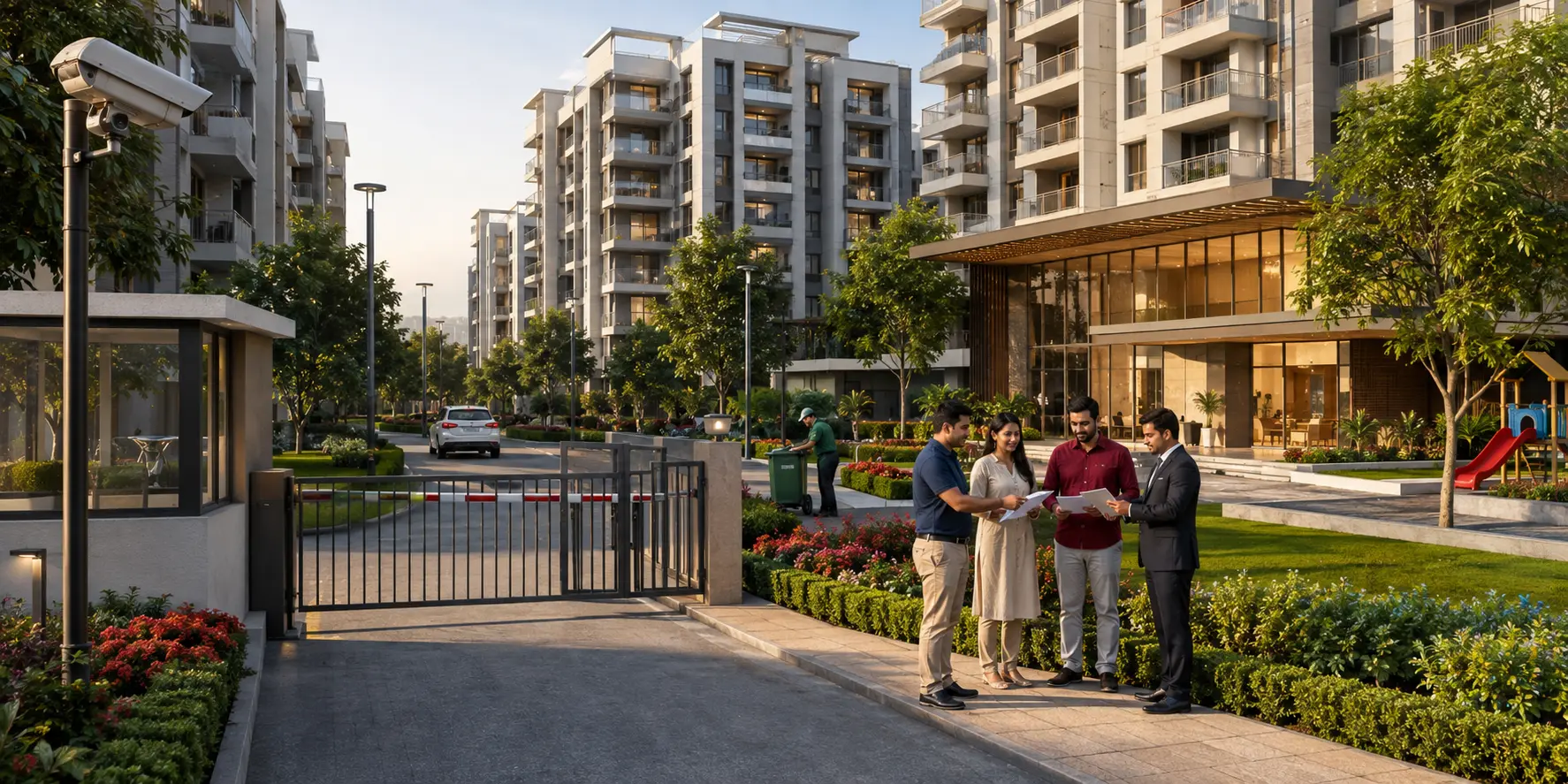
society-maintance.webp

GST note:  Whether GST applies often comes down to whois running your maintenance. If your society has outsourced maintenance to a professional facility management company (like JLL, CBRE, or similar third-party operators), 18% GST typically applies on the full billed amount once the per-flat monthly charge crosses ₹7,500 and the entity's annual turnover exceeds ₹20 lakh - which most professionally-managed societies cross easily. If your RWA self-manages maintenance directly - without outsourcing to an external company or hiring exclusive office staff - it's usually treated as GST-exempt, since self-managed associations acting purely for their own members' benefit generally fall outside the tax net. Smaller, self-run Tricity societies often benefit from this exemption, while larger townships using third-party facility managers almost always see GST added to their bills.  

What RERA Says About Maintenance Charges  

The Real Estate (Regulation and Development) Act, 2016 (RERA) - explained in detail in our guide to what is RERA  -  puts real guardrails around how builders and RWAs can handle maintenance money:  

  • Builders must disclose maintenance rates upfront- the rate per sq ft, what it includes, and the escalation formula - before you sign the sale agreement.  
  • Builders can only collect advance maintenance for a limited period- generally up to the point the RWA is formally constituted, and often capped around 12–24 months' worth at possession.  
  • Funds must sit in a separate, dedicated account- maintenance money cannot be mixed with the builder's construction funds, and cannot be treated as builder profit.  
  • The builder remains responsible for maintenance until the RWA takes over- and must then hand over all funds, documents, and common-area assets to the association.  
  • Every allottee is legally obligated to help form the RWA- Section 19(9) of the RERA Act places this responsibility on homebuyers themselves, not just the builder.  

If a builder continues charging maintenance without transparency or refuses to hand over documents once the RWA is due to form, residents can file a formal complaint with the state RERA authority - in Punjab's case, RERA Punjab. If you're unsure whether your project falls under RERA, PUDA, or GMADA jurisdiction, our RERA vs PUDA vs GMADA guide  breaks down exactly which authority handles what.  

Punjab's Own Law: The Apartment Ownership Act, 1995 (PAPRA)  

Because the Tricity falls under Punjab, there's a state-specific law that matters more here than RERA alone: the Punjab Apartment Ownership Act, 1995  - the official text is hosted on GMADA's own website - commonly discussed alongside the Punjab Apartment and Property Regulation Act, 1995 (PAPRA). This law predates RERA and specifically governs how apartments, associations, and common areas function in Punjab. (For background on GMADA itself, see What Is GMADA? How It Actually Works, and for the older Punjab urban authority it works alongside, What Is PUDA Punjab?)  

Key points every Tricity apartment owner should know:  

  • RWA formation is mandatory, not optional.Under Section 17-A, once one-third of the apartments in a project have been allotted, sold, or transferred, the promoter (builder) must apply to the competent authority to register the association. If the builder doesn't, allottees themselves can make the application.  
  • An Occupation Certificate is required before RWA registration.Courts have held that a Resident Welfare Association cannot be legally registered without the project first having a completion and occupation certificate - a useful fact if your builder is dragging its feet on either.  
  • Once registered, the RWA takes over full responsibilityfor administration, maintenance, and upkeep of common areas - and all the promoter's prior duties and rights over common facilities pass to the association.  
  • RWAs can also be registered under the Societies Registration Act, 1860, depending on how the original developer structured the project - so it's worth checking which registration applies to your specific society.  

What Your RWA Can (and Can't) Do  

Once formed, the RWA effectively runs local governance for your community. Its powers under Punjab's apartment law include:  

  • Managing and maintaining common areas, facilities, and services  
  • Assessing and collecting maintenance charges from all owners  
  • Repairing, reconstructing, or rebuilding damaged property  
  • Framing bye-laws for community conduct, use of amenities, and dispute resolution  

What it cannot do, regardless of what's written in its own bye-laws:  

  • Charge arbitrary, undisclosed, or ad-hoc fees not covered in the original disclosure  
  • Use maintenance funds for anything other than upkeep of common areas  
  • Withhold basic services (water, security access) as a way to force payment disputes - this is a common but legally shaky RWA practice that regularly ends up in consumer courts  
  • Refuse to conduct elections or General Body Meetings indefinitely - RWA office-bearer terms and elections are meant to be periodic, not permanent  

Common Disputes - and How to Handle Them  

Real cases bear this out - even RWAs on the civic-authority side see friction over maintenance rates, as with Mohali residents associations seek hike in park maintenance charges. At the resident level, the most frequent Tricity RWA disputes fall into a few recurring patterns:  

  1. Maintenance hiked without notice or breakdown.You're entitled to an itemised breakdown of what your charges cover and why they increased - insist on seeing the audited accounts at the AGM.  
  2. Builder delaying RWA handover.If your builder is still collecting maintenance years after two-thirds of flats are sold, that's a red flag - push for the Section 17-A application, or file it yourselves as allottees.  
  3. Disputes over amenity access or parking allocation.These are typically resolved through the RWA's own bye-laws first; unresolved disputes can go to the Registrar of Societies, which functions somewhat like a court for society-related complaints.  
  4. No response to formal complaints.A legal notice to the RWA/builder, followed by a complaint to the Registrar of Societies or RERA Punjab (depending on the issue), is the standard escalation path.  

Practical Checklist Before You Buy Into a Gated Society  

  • Ask for the maintenance rate per sq ft in writing, along with what it includes, before signing the buyer agreement  
  • Confirm whether the project already has an Occupation Certificate - this affects when the RWA can legally form  
  • Check how many flats have been sold/transferred so far - this tells you how close the project is to mandatory RWA formation under Section 17-A  
  • Ask to see at least one recent maintenance account statement or audit, if the society is already operational  
  • Clarify whether the sinking/reserve fund is separate from monthly maintenance, and how much has been accumulated  
  • If buying resale, ask the current owner for the last 2–3 maintenance receipts and any pending dues - unpaid dues can sometimes attach to the unit, not just the previous owner  
Share:
Related Posts
News insight
3 BHK Flats in Mohali: Complete 2026 Buying GuideJul 17, 2026
3 BHK Flats in Mohali: Complete 2026 Buying Guide

A practical, RERA-verified 2026 guide to 3 BHK flats in Mohali covering top gated society projects,...

Green Lotus Utsav Zirakpur: Luxury Homes With Green LivingJul 08, 2026
Green Lotus Utsav Zirakpur: Luxury Homes With Green Living

Explore Green Lotus Utsav in Zirakpur — IGBC Platinum pre-certified 3 BHK, 4 BHK+1, 5 BHK+1 and 6 BH...

Is The Tiara New Chandigarh Worth Buying in 2026?Jun 03, 2026
Is The Tiara New Chandigarh Worth Buying in 2026?

Thinking of buying at The Tiara, New Chandigarh? We break down location, pricing, RERA status, and w...

Live ChatOnline

Hi there! How can we help you today?

Your experience on this site will be improved by allowing cookies. Read our Cookie Policy