

Hi there! How can we help you today?

Buying a Home
Home Construction Styles: Mud Houses to Modern Mivan
Home construction in India tells the story of a family's dreams, savings and years of hard work. This guide walks throug...
Affordable housing helps families find homes within their income range. PMAY-U 2.0 supports eligible urban families through different housing options. EWS, LIG…Affordable housing helps families find homes within their income range. PMAY-U 2.0 supports eligible urban families through different housing options. EWS, LIG and MIG groups have different income limits and benefits.







Every family dreams of a home they can call their own. But for a number of Indians, that dream feels far away because prices keep climbing every year. This is where affordable housing steps in. It is not just a policy word.
It is a promise that a decent roof should not cost a lifetime of savings. Millions of urban households in India still live in rented rooms, shared flats or homes that are simply too small for the family, and closing that gap is one of the biggest challenges the country faces today.
In this guide, we will walk through what it truly means to own a budget home in 2026, which schemes can actually help you, and the small mistakes that can cost you your dream home. Grab a cup of chai and read on, because this one might change how you plan your next big move.
Affordable housing is a home that fits a family's income without draining their future. The government sets fixed limits on price, size and buyer income to decide who qualifies. Under Pradhan Mantri Awas Yojana Urban 2.0 (PMAY-U 2.0), a house counts as affordable when its value stays under a set ceiling and the buyer belongs to one of three income groups.
Income Group | Annual Household Income | Who It Usually Covers |
EWS (Economically Weaker Section) | Up to ₹3 lakh | Daily wage workers, small vendors, domestic staff |
LIG (Low Income Group) | ₹3 lakh to ₹6 lakh | Clerks, junior staff, small shop owners |
MIG (Middle Income Group) | ₹6 lakh to ₹9 lakh | Salaried employees, small business owners |
Families in the LIG bracket often search for low income housing close to their workplace, and PMAY-U 2.0 was designed with exactly this group in mind. The scheme also caps the carpet area at 120 square metres and the loan eligible for subsidy at ₹25 lakh, so the benefit stays focused on people who need it the most.
The ₹6–9 lakh MIG band above applies specifically to the Interest Subsidy Scheme vertical. For other purposes under the wider mission, the official PMAY-U FAQ splits Middle Income into two bands — MIG-I (₹6–12 lakh) and MIG-II (₹12–18 lakh) — so don't assume you're ineligible everywhere if you earn between ₹9 lakh and ₹18 lakh; check which vertical applies to you.
India's cities are growing fast, and so is the gap between what people earn and what a house costs. Reports from housing bodies have long pointed to a shortage of urban homes running into millions of units, most of it concentrated in the EWS and LIG segments.
Rents keep rising in fast-growing towns, and young families often end up paying more for a small rented flat than they would for an EMI on their own home. This gap is exactly why the government keeps updating its housing schemes, and why private developers are now paying closer attention to smaller, smarter and cheaper homes.
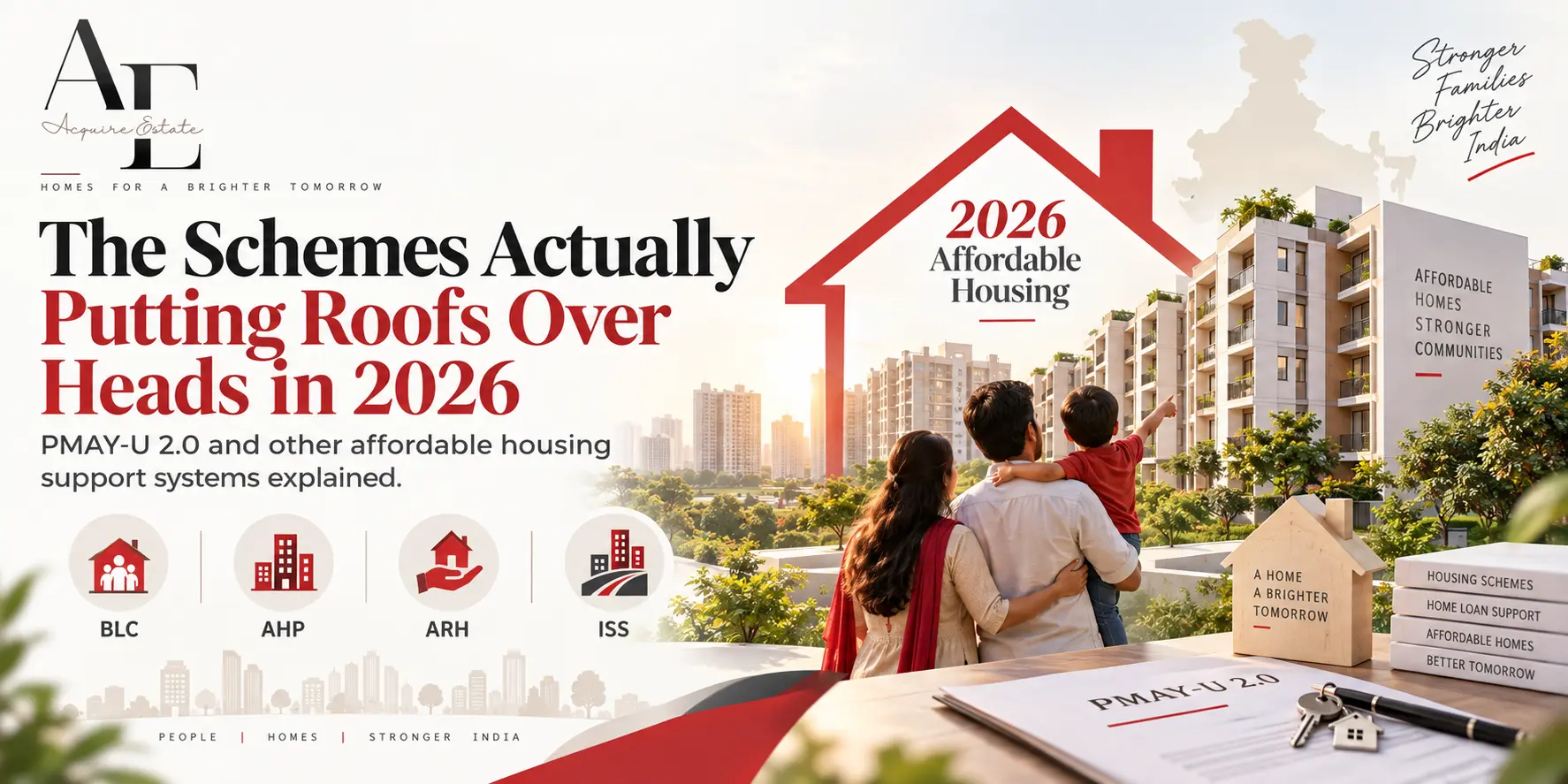
PMAY-U 2.0 is one of the largest affordable housing schemes in the world. Launched on September 1, 2024, it aims to support one crore urban families over five years, with central assistance of up to ₹2.50 lakh crore. The scheme runs through four verticals, and each one solves a different housing problem.
Under the ISS vertical, eligible families receive a 4% subsidy on loans up to ₹8 lakh. The total benefit can reach ₹1.80 lakh, paid out in five yearly instalments of ₹36,000 each. The disbursal process is monitored by the Central Sanctioning and Monitoring Committee (CSMC) along with the participating lending institutions, which keeps the process transparent and easy to track.
One change worth knowing about is geo-tagging: every construction site under the scheme now gets photo evidence stamped with location and time. This system was first introduced under the original PMAY-U mission and has since been carried forward under PMAY-U 2.0. States like Andhra Pradesh, Karnataka and Kerala have shown strong results with this system, since it cuts down false claims and construction delays.
There is one more definition worth knowing, and it comes from the GST Council, not just from PMAY-U 2.0. A flat is treated as affordable housing for tax purposes when its carpet area stays within 60 square metres in metro cities or 90 square metres in non-metro cities, and its price does not cross ₹45 lakh. Homes that meet this test attract GST at just 1 percent, compared to 5 percent on regular under-construction flats. This single rule is why so many builders now design smaller, smarter layouts, and why cities near Chandigarh, Mohali and Zirakpur, included, see more launches in this exact size and price bracket.
Paperwork can feel confusing, but most affordable housing applications ask for a similar set of documents. Keeping these ready before you start saves weeks of back and forth.
Government support is not the only route. If you are exploring affordable housing options, look beyond PMAY-U 2.0 too. Many private developers now build homes made specifically for first-time buyers, and several of these projects carry RERA registration under the affordable housing category set by individual states. Whichever project you consider, verify its RERA registration number on your state's official RERA portal before you commit — the same rule applies whether it's a government scheme or a private developer's "affordable" listing.
This shift is visible close to home too. In fast-growing belts around big cities, more families are choosing to settle just outside the main urban core, where land is cheaper and new infrastructure keeps arriving. It is a pattern playing out across many Indian cities, not just one.
Tier 2 and Tier 3 cities such as Zirakpur, Kharar and Panchkula are seeing a steady rise in budget-friendly housing projects. These offer city-like amenities, from lifts to security, at a fraction of what similar flats cost in bigger metros.
If buying feels like a big step right now, renting is not a step down. Affordable rental housing complexes under the ARH vertical offer a dignified stay close to workplaces, built mainly for migrant workers and young professionals who are just starting out.
It also helps to check what your state offers. Several states run their own affordable housing programs alongside the central scheme, sometimes with extra benefits for women, senior citizens or persons with disabilities. A quick visit to your state housing board website can reveal options you may not know about.
For a family that has spent years in a small rented room, affordable housing is not just a government scheme. It is the first night their children sleep in a room they can call their own. It is the quiet relief of not worrying about a landlord's phone call. Behind every housing number and every policy document, there is a family's small, real victory. That is worth remembering every time these schemes feel like just paperwork.
It also pays to compare a few localities before you decide. Two projects can carry the same price tag on paper, yet feel completely different once you factor in daily commute time, nearby schools, water supply and how far the nearest market or hospital sits. A slightly smaller home in a well-connected pocket often serves a family better than a bigger one that adds an hour to every commute.
Owning a home should not feel like an impossible dream. With the right scheme, the right paperwork and a little patience, it does not have to be. Whether you choose a central scheme, a state programme or a private project built for first-time buyers, take your time, verify every document and pick the option that actually fits your life, not just your budget on paper. Start small if you have to. Read every clause twice. Ask questions until they make sense. A home bought with patience always feels sweeter than one bought in a rush, and this is one decision worth getting right the first time.
It stands for Pradhan Mantri Awas Yojana Urban 2.0, the Government of India's urban housing mission launched on September 1, 2024.
Families under EWS, LIG or MIG income groups who do not own a pucca house anywhere in India and have not received central housing help before.
Up to ₹1.80 lakh, given as a 4% interest subsidy on loans up to ₹8 lakh, paid in five yearly installments.
You can apply online at pmaymis.gov.in or visit your nearest Common Service Centre for offline help.
No. The scheme also covers construction, plot-plus-construction and rental housing through its different verticals.
Home construction in India tells the story of a family's dreams, savings and years of hard work. This guide walks throug...

NRI property buying in India comes with strict FEMA rules, a freshly updated 2026 tax law, revised TDS sections, home lo...
Thinking of buying into a gated society in Mohali, Zirakpur, or New Chandigarh? This guide breaks down how maintenance c...
Hi there! How can we help you today?