Local Bodies in Punjab: Municipal Corporation vs Council vs Improvement Trust
Local bodies in Punjab shape everything from your water bill to your building plan approval. This guide breaks down the Municipal Corporation,…Local bodies in Punjab shape everything from your water bill to your building plan approval. This guide breaks down the Municipal Corporation, Municipal Council and Improvement Trust system, the laws behind them, their money and exactly where to complain when things go wrong.
Ask any homeowner in Punjab who has waited weeks for a leaking sewer line to get fixed and they will tell you something simple: it is not the state government you call first, it is your local body.
Local bodies in Punjabare the closest layer of government to ordinary people and yet most residents cannot name the difference between a Municipal Corporation Punjab office and a Municipal Council Punjab office, let alone explain what an Improvement Trust Punjab actually does.
That confusion costs people time, money and sometimes their peace of mind when a building plan gets stuck or a property tax notice does not make sense. This guide untangles the entire system, with verified facts, real addresses and a complaint route you can actually use.
What Exactly Is a Local Body and Why Did Punjab Need One?
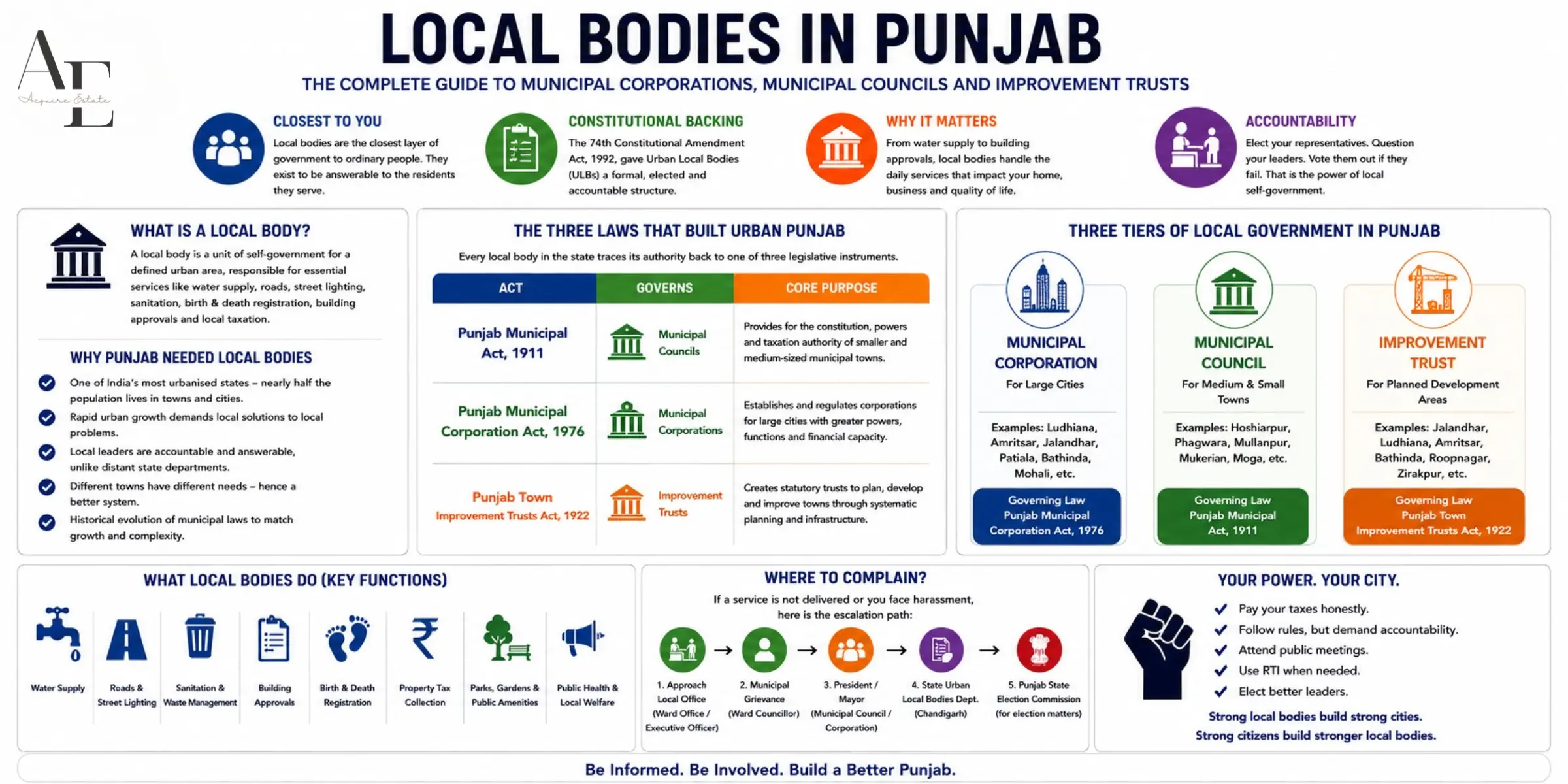
A local body, in the simplest sense, is a unit of self-government created to handle the everyday needs of a defined urban area - water supply, roads, street lighting, sanitation, birth and death registration, building approvals and local taxation.
State governments cannot realistically manage every street and drain from a state capital, so the Constitution of India, through the 74th Constitutional Amendment Act of 1992 gave urban local bodies (ULBs) a formal, elected and accountable structure.
Punjab had already experimented with municipal governance long before that amendment, going back to British-era municipal committees, but the 74th Amendment gave the system constitutional teeth: regular elections, reserved seats for women and weaker sections, State Finance Commissions and a clearer division of duties.
Punjab is one of India's most urbanised states, with close to half its population now living in towns and cities rather than villages. That single fact explains the pressure on local bodies in Punjab today - more people need water connections, more colonies need sewer lines and more buildings need approvals, all while these institutions still run on decades-old laws.
The need for a local body is not just administrative convenience; it is a matter of accountability that people can actually reach. A state minister sitting in Chandigarh cannot personally inspect a broken manhole cover in a Zirakpur colony, but a Municipal Council President and an Executive Officer can be approached, questioned and, in an elected system, eventually voted out if they fail.
That proximity is the entire point of local self-government and it is what separates a Municipal Corporation Punjab office from a distant state department - it exists specifically to be answerable to the people who live within its boundary.
It also matters that Urban Local Bodies (ULB) Punjab institutions are not a single uniform category. A one-size approach would have failed a state with cities as large as Ludhiana and towns as small as a newly upgraded Nagar Panchayat.
That is exactly why Punjab, like most Indian states, built a tiered system - a Corporation for the biggest cities, a Council for everything in between and a specialised Improvement Trust wherever a town needed dedicated planning capacity that an ordinary municipal committee could not provide on its own.
The origin story goes back further than most residents realise. Municipal committees in Punjab existed in some form under British administration well before Independence, largely to manage sanitation, roads and local taxation in cantonment and civil-line towns.
As those towns grew through the twentieth century, the state government layered on more specific laws - first the 1911 Actfor general municipal governance , then the 1922 Act to handle planned expansion separately and finally the 1976 Act once cities like Ludhiana and Amritsar had grown too large and complex for the older municipal committee framework to manage effectively.
Each law was essentially a response to a growth problem the previous framework could not solve and that pattern is still visible today in towns like Zirakpur, which grew so quickly that its Nagar Panchayat status became inadequate within a matter of years.
The Three Laws That Built Urban Punjab
Every local body in the state traces its authority back to one of three legislative instruments. Knowing which law governs which body is the fastest way to understand who has power over what.
Act
Governs
Core Purpose
Punjab Municipal Act, 1911
Municipal Councils
Provides for the constitution, powers and taxation authority of smaller and medium-sized municipal towns.
Punjab Municipal Corporation Act, 1976
Municipal Corporations
Establishes corporations for large cities, defines the Mayor-Commissioner system, and lists obligatory and discretionary functions.
Punjab Town Improvement Act, 1922
Improvement Trusts
Created to plan, acquire land for, and develop new residential and commercial schemes in expanding towns.
A fourth statute, the Punjab Regional and Town Planning and Development Act, 1995, does not create a municipal body at all but sits above this entire structure - it is the law under which development authorities such as GMADA (Greater Mohali Area Development Authority) and PUDA are constituted and it explains why some of Punjab's fastest-growing towns are shaped more by a development authority than by their own municipal council.
How Local Bodies in Punjab Are Divided: Corporation, Council and Trust
There are three distinct categories of urban local bodies in Punjab and each one exists for a different reason.
Municipal Corporation - the government of a large city, typically one crossing a significant population threshold, headed by an elected Mayor with a Commissioner as the administrative head.
Municipal Council - the government of a mid-sized or smaller town, headed by an elected President with an Executive Officer managing daily administration.
Improvement Trust - a specialised development body, not a general government, created specifically to acquire land and build planned housing and commercial schemes in a town.
As of the 2026 municipal election cycle, Punjab's urban local bodies numbered 13 Municipal Corporations, alongside roughly76 Municipal Councils and 21 Nagar Panchayatsthat went to the polls in May 2026, in addition to the five corporations -Amritsar, Jalandhar, Ludhiana, Patiala and Phagwara- that had already voted in December 2024.
Improvement Trusts exist as a separate, parallel category and are not counted within these election figures, since their members are appointed rather than directly elected.
Municipal Corporation Punjab: Structure, Powers and Money
A Municipal Corporation Punjab body is constituted under the Punjab Municipal Corporation Act 1976, an Act that received presidential assent on 21st December 1976 and was published in the Punjab Government Gazette in January 1977.
It governs the largest cities in the state - Amritsar, Ludhiana, Jalandhar, Patiala, Bathindaand, more recently, cities such as Mohali, Batala, Abohar, Kapurthala, Moga, Barnala, Phagwara and Pathankot,after Punjab expanded the corporation list from 10 to 13 cities between 2019 and the present.
Who Runs It
A Corporation is led by an elected Mayor, assisted by a Senior Deputy Mayor and Deputy Mayor, who together represent the political and ceremonial leadership of the city. Day-to-day administration, however, sits with the Commissioner, an IAS or state civil service officer appointed by the state government, who executes the Corporation's resolutions, manages staff and is legally accountable for civic services.
What It Is Obligated to Do
Section 44 of the Punjab Municipal Corporation Act 1976 lists 21 obligatory functions of Municipal Corporation Punjab bodies - duties they must perform regardless of budget pressure. These include:
Public vaccination and inoculation and general public health measures
Registration of births and deaths within the city
Construction and maintenance of municipal markets and slaughterhouses, along with regulation of all markets
Water supply and maintenance of waterworks
Street lighting across public roads and spaces
Construction, maintenance and improvement of public streets, bridges, culverts and causeways
Drainage, sewerage and the removal of obstructions from public places
Beyond these obligatory duties, Corporations may take up discretionary functions, such as building public libraries, parks, community halls or housing schemes, depending on available funds.
In practice, obligatory functions consume most of a Corporation's annual budget, which is precisely why discretionary, quality-of-life projects tend to move slower in cash-strapped Corporations than in financially healthier ones like Ludhiana or Amritsar.
Where the Money Comes From
Corporation revenue in Punjab comes from four broad streams: Property Tax, Trade Licence fees , water and sewerage user charges and government grants - both tied grants that must be spent on specific central schemes and untied grants that Corporations can allocate at their own discretion. Property tax remains the single largest source of self-generated municipal revenue across the state.
The 13 Municipal Corporations of Punjab
Municipal Corporation
District
Amritsar
Amritsar
Ludhiana
Ludhiana
Jalandhar
Jalandhar
Patiala
Patiala
Bathinda
Bathinda
Phagwara
Kapurthala
Mohali (SAS Nagar)
SAS Nagar
Moga
Moga
Pathankot
Pathankot
Hoshiarpur
Hoshiarpur
Kapurthala
Kapurthala
Batala
Gurdaspur
Abohar
Fazilka
Barnala is also functioning as a Municipal Corporation following the 2026 local body election cycle; readers verifying an exact live count should cross-check the Department of Local Government Punjab portal, since upgrades to corporation status happen through government notification and can change between election cycles.
Municipal Council Punjab: The Backbone of Punjab's Growing Towns
A Municipal Council Punjab body is constituted under the older Punjab Municipal Act, 1911 and governs towns that have not yet reached corporation-level population or revenue thresholds. This is the most numerous category of urban local body in the state, covering everything from mid-sized district towns to fast-growing satellite towns around Chandigarh.
Who Runs It
A Municipal Councilis headed by an elected President, supported by ward councillors, while an Executive Officer- typically drawn from the Punjab Civil Serviceor a departmental cadre- handles daily implementation, much like a Commissioner does for a Corporation but at a smaller scale.
What It Does and How It Earns
Municipal Councils perform largely the same categories of obligatory functions as Corporations - water supply, street lighting, drainage, sanitation, birth and death registration and local road maintenance - but on a tighter budget.
Their revenue mix leans more heavily on state and central grants than a large Corporation's does, because smaller towns generate far less property tax and trade licence income relative to their servicing costs. Councils also collect house tax, fire tax in some towns and fees for building plan approvals.
For water and sewerage infrastructure specifically, many Councils in the Mohali–Zirakpur–Kharar belt do not build and operate these systems entirely on their own.
Large trunk infrastructure is often planned and executed through the Punjab Water Supplyand Sewerage Board (PWSSB) , a state-level technical body that supports Councils and Corporations with engineering capacity they may not have in-house.
This is one reason a Council can request funds for a project but still depend on a state-level agency to actually deliver the pipeline or treatment plant.
Building plan approval is another area where a Municipal Council's authority is not absolute. Within a Council's own municipal limits, the Council's technical wing approves residential and commercial building plans.
But in towns falling under a development authority's planning jurisdiction - such as Zirakpur, Kharar or Banur, all of which sit withinGMADA's zoning and land use approval framework - plan approval and change-of-l permissions often route through GMADA rather than the Council alone, which is a detail many first-time property buyers overlook.
Improvement Trust Punjab: Born to Build, Not Just to Govern
Improvement Trusts are the least understood of the three, largely because they are not general-purpose governments at all. They were created under the Punjab Town Improvement Act, 1922,at a time when British-era Punjab towns were expanding faster than their existing municipal committees could plan for.
Rather than asking an already-stretched municipal committee to also acquire land and build new colonies, the government created a dedicated body: an Improvement Trust - whose sole job was planned expansion.
Why It Was Formed
The logic was straightforward: municipal committees of the early 20th century were built to manage existing streets and services, not to acquire raw land, lay out new sectors and sell developed plots.
Improvement Trusts filled that gap. The Amritsar Improvement Trust, for instance, was constituted on2nd April 1949 specifically to develop residential and commercial plots for the city and it has since developed thousands of acres across multiple schemes.
Ludhiana, Bathinda, Faridkot, Malerkotla and Sangrur are among the other Punjab towns that continue to run active Improvement Trusts today.
Who Runs It and Where the Money Comes From
An Improvement Trust is headed by a government-appointed Chairman, with an Executive Officer managing operations. Unlike Corporations and Councils, Trusts do not rely primarily on property tax.
Their main income comes from selling or leasing developed residential and commercial plots, along with loans raised for specific schemes and, where applicable, government grants for particular development projects.
This model has real staying power. The Ludhiana Improvement Trust and Bathinda Improvement Trust, for example, continue running active e-auction and allotment schemes for residential and commercial plots even decades after their original formation and Bathinda's Trust alone has delivered around 15 separate development schemesover the years.
That longevity is exactly why Improvement Trusts still matter in 2026, even though newer development authorities like GMADAand PUDA now handle much larger regional projects - Trusts continue to manage older, established schemes and localised plot allotments that a large regional authority is not structured to handle at that granularity.
Difference Between Municipal Corporation, Municipal Council and Improvement Trust
Feature
Municipal Corporation
Municipal Council
Improvement Trust
Governing law
PMC Act, 1976
Punjab Municipal Act, 1911
Punjab Town Improvement Act, 1922
Applies to
Large cities
Mid-sized and small towns
Selected expanding towns
Elected head
Mayor
President
None - Chairman is appointed
Administrative head
Commissioner
Executive Officer
Executive Officer
Core role
Full municipal governance
Full municipal governance
Land acquisition and planned development only
Main revenue
Property tax, grants, user fees
Grants, house tax, fees
Plot sale/lease, loans
The Department of Local Government Punjab: The Umbrella Above Every Local Body
Every Corporation, Council and Improvement Trust in the state ultimately answers to a single nodal department - the Department of Local Government Punjab,headquartered at PunjabMunicipal Bhawan in Sector 35-A,Chandigarh .The department is organised into functional wings that mirror what local bodies actually need on the ground: an Engineering Branch that supports infrastructure projects, a Water Supply and Sewerage wing that coordinates with PWSSB, an Election Branch that conducts municipal polls and Chief Engineers dedicated separately to Councils and Corporations.
This structure is also why building plan approval processes in Punjab local bodies are not entirely uniform - while each Corporation and Council has its own technical staff, larger infrastructure and policy decisions are still routed through this central department.
The department also oversees agencies that support local bodies rather than replace them, such as the Punjab Municipal Infrastructure Development Company(PMIDC) which helps fund and execute larger municipal infrastructure projects that individual Councils could not finance alone.
Understanding this layered structure - local body, department and supporting state agency - helps explain why a single civic issue, like a stalled sewage project, can sometimes take months to resolve: multiple offices, not just one Council, may need to sign off before work begins.
Are These Bodies Autonomous? Where Does the Money Actually Come From?
Local bodies in Punjab are described as institutions of self-government, but their autonomy is partial rather than absolute. They elect their own leadership and pass their own resolutions, yet they remain financially dependent on higher levels of government for a large share of their budgets and the state government retains significant oversight powers, including the ability to appoint administrators when an elected body's term lapses before fresh elections are held.
Funding flows through two broad channels. The first is direct devolution from the Government of India, typically routed through central schemes such as AMRUT- Atal Mission for Rejuvenation and Urban Transformation and the Swachh Bharat Mission , which provide tied grants for water supply, sewerage and sanitation infrastructure.
The second is state-level support from the Punjab government, disbursed through the Department of Local Government as both tied grants for specific schemes and untied grants that a Corporation or Council can spend at its own discretion, alongside the Punjab Municipal Fund that pools resources for redistribution to smaller, revenue-poor bodies.
In practice, most Municipal Councils and several Corporations remain unable to meet their full expenditure needs from property tax and user charges alone, which keeps them structurally reliant on this two-tier grant system.
Local Bodies of Punjab's Fastest-Growing Belt: Mohali, Zirakpur, Kharar, New Chandigarh and Banur
Nowhere is the tension between municipal governance and rapid urban growth more visible than in the Mohali (SAS Nagar) district, which borders Chandigarh and has absorbed a large share of the region's real estate expansion over the last two decades.
Mohali
Mohali is governed by the Mohali Municipal Corporation ,also referred to as Municipal Corporation SAS Nagar, which functions from the Municipal Corporation Complex in Sector 68, Mohali . The Corporation has 50 wards and held its most recent election on 26th May 2026, alongside several neighbouring Municipal Councils in the same district.
Zirakpur is governed by the Municipal Council Zirakpur ,constituted under the Punjab Municipal Act, 1911. The town's civic journey has been unusually fast: it operated as a Nagar Panchayat until the mid-2000s before being upgraded to a full Municipal Council by around 2010, driven by explosive population growth from roughly 25,000 residents in the 2001 Census to more than 95,000 by 2011, a decadal growth rate far above Punjab's state average.
In 2026, Punjab's Local Government Minister publicly announced plans to upgrade Zirakpur's civic status from Municipal Council to full Municipal Corporation, citing the town's rapid urban expansion and the need for stronger governance capacity; this upgrade was described as being implemented from Zirakpur's next civic body election rather than through an immediate notification.
Kharar
Kharar functions under the Municipal Council Kharar, one of several Councils operating within Mohali district alongside Kurali, Naya Gaon, Derabassi, Lalru and Banur.
Like Zirakpur, Kharar has seen substantial residential development pressure due to its proximity to Chandigarh and Mohali and much of its planned sector development is guided in parallel by GMADA rather than the Council alone.
Buyers tracking this corridor can also browse our Kharar projects.
New Chandigarh (Mullanpur)
New Chandigarh, developed around Mullanpur, does not have its own independently elected Municipal Corporation or Council in the way Mohali or Zirakpur do. It is planned and administered directly by GMADA as a purpose-built extension of Chandigarh, envisioned as a self-sustaining township to absorb spillover growth from Chandigarh and Mohali over a twenty-year horizon.
This is an important distinction for anyone buying property in the area - civic and planning decisions here run through GMADA's master plan process rather than through a separately elected municipal body.
Banur is served by the Municipal Council Banur, a smaller Council with 13 wards, whose returning officer functions are handled through the Tehsil Office, Banur. Like Kharar and Zirakpur, Banur falls within GMADA's development jurisdiction for planning purposes, even while its day-to-day municipal services remain the Council's responsibility.
Why GMADA's Development Often Outpaces the Corporations and Trusts
GMADA or the Greater Mohali Area Development Authority, was constituted on 14th August 2006 under Section 29(1) of the Punjab Regional and Town Planning and Development Act, 1995.
Its jurisdiction covers Mohali, Banur, Zirakpur, Derabassi, Kharar, Mullanpur, Fatehgarh Sahib, Mandi Gobindgarh and Roopnagar and it is governed by a Chief Administratorunder the state's Directorate of Town and Country Planning.
The reason GMADA's growth often looks more organised and faster-paced than that of the region's Municipal Councils comes down to mandate and money. A Municipal Council is built to run existing services on a largely fixed, grant-dependent budget.
GMADA, on the other hand, is a development authority with the specific power to acquire land, plan entire new sectors and fund infrastructure through the sale of developed plots and land-pooling schemes such as Aerocity, Eco City and Expo City.
It is essentially working with the same land-monetisation model that Improvement Trusts historically used, but at a much larger regional scale and with a modern master-planning framework running through 2031 and beyond. Municipal Councils, in contrast, are catching up to service demand rather than getting ahead of it.
How Do Cities Get Graded?
Punjab's urban local bodies are assessed annually through the Ministry of Housing and Urban Affairs' Swachh Survekshan,a nationwide cleanliness and sanitation ranking that scores cities on solid waste management, sanitation infrastructure, citizen feedback and certification standards such as Open Defecation Free(ODF) status.
Corporations and Councils are also measured against Service Level Benchmarks covering water supply coverage, sewerage network coverage and grievance redressal timelines, which in turn influence how much untied grant funding a body becomes eligible for under schemes like AMRUT.
These scores matter beyond bragging rights. A poor Swachh Survekshan ranking or weak service-level benchmark performance can affect a local body's eligibility for future central grants, since schemes like AMRUT are explicitly designed to reward reform-linked and outcome-linked performance rather than simply distributing funds evenly.
In practical terms, this means a Municipal Council that improves its waste segregation and citizen grievance response time is not just improving day-to-day life for residents - it is also improving its own future funding position, which is part of why local body leaders increasingly campaign on cleanliness and service delivery rather than only on infrastructure promises.
Zirakpur's Funding Story: What's Verified and What Isn't
Zirakpur is frequently cited in local discussions as a town that has punched above its weight in attracting central government attention and there is genuine evidence for this: its extraordinary population growth made it an early and consistent beneficiary of schemes such as AMRUTand Swachh Bharat Mission funding and it is currently in line for an upgrade to full Municipal Corporation status precisely because of that growth trajectory.
However, a specific claim sometimes repeated locally - that Zirakpur was ranked the number one recipient of direct central government grants among Punjab's local bodies at some point - could not be verified against any official Department of Local Government Punjabor Ministry of Housing and Urban Affairs record during research for this article. Readers should treat that particular claim as unconfirmed rather than established fact unless a specific government notification or ranking report can be cited.
How to File a Complaint Against a Local Body in Punjab ?
Every resident has the right to raise a grievance against a Municipal Corporation, Municipal Council or Improvement Trust in Punjab and the state has centralised this process under the Department of Local Government.
To file a complaint online, residents log in with a registered mobile number on the mSeva portal, select the relevant complaint category - such as water supply, drainage, sanitation or an issue with a specific employee - enter the exact location of the problem, attach supporting photos if available and submit.
Every complaint receives a tracking reference that can be checked under the 'My Complaints'section of the same portal. This information is sourced from the official Department of Local Government Punjab website and its listed contact channels.
Property Tax and Building Plan Approval: A Quick Primer
Property tax in Punjab's Municipal Corporations and Councils is calculated on the basis of a property's annual or capital value, factoring in covered area, location, construction type and usage (residential, commercial or industrial), with the exact formula and rate slabs notified separately by each local body and the state government.
Building plan approvals, similarly, are processed by the respective Corporation, Council or, in GMADA's jurisdiction, by GMADA itself rather than the local Council, depending on where the plot falls.
For private builder projects specifically, approval also depends on RERA registration — see our RERA vs PUDA vs GMADA verification guide to understand who checks what.
Anyone constructing or buying property in Punjab should confirm with the relevant office directly, since exact tax rates and approval fees are revised periodically and unverified pricing figures should never be relied upon without checking the current notification.
Conclusion: Why Understanding Local Bodies in Punjab Actually Matters
Local bodies in Punjab are not a bureaucratic footnote - they are the institutions that decide whether your water pressure improves, whether your building plan gets approved on time and whether your complaint about a broken street light gets resolved in a week or a year.
Whether you are dealing with a Municipal Corporation in a major city, a Municipal Council in a fast-growing town like Zirakpur or Kharar or an Improvement Trust managing a decades old housing scheme in Amritsar or Ludhiana, knowing which local body has jurisdiction and which law governs it puts you in a far stronger position as a citizen.
The larger story here is one of catching up. Local bodies in Punjab were largely designed for a slower, smaller version of the state than the one that exists today and the strain shows in delayed approvals, patchy sanitation scores and a heavy dependence on state and central grants that leaves very little room for ambitious, self-funded projects.
Development authorities like GMADA have shown what is possible when a body has land-based revenue and a long planning horizon and there is a real case for local bodies in Punjab to be given more of that same financial room.
Until then, the most useful thing any resident, buyer or business owner can do is understand exactly which local body governs their property, what that body is legally obligated to provide and precisely how to escalate a complaint when local bodies in Punjab fall short of that obligation.
Frequently Asked Questions
1. What is the difference between Municipal Corporation and Municipal Council in Punjab?
A Municipal Corporation governs large cities under the Punjab Municipal Corporation Act 1976 and is headed by an elected Mayor with a Commissioner as administrative head. A Municipal Council governs smaller towns under the Punjab Municipal Act 1911 and is headed by an elected President with an Executive Officer handling administration.
2. How many Municipal Corporations are there in Punjab?
Punjab currently has 13 Municipal Corporations, following the addition of Batala, Kapurthala and Abohar in 2019 and further upgrades since, on top of the original 10.
3. Why are there sometimes said to be 12 Municipal Corporations in Punjab?
The figure of 12 sometimes circulates because Punjab's corporation count has changed multiple times in recent years as towns are upgraded from Municipal Council status. Based on the most recent available records, the verified current figure is 13 and readers should always confirm against the Department of Local Government Punjab portal, since a fresh upgrade notification can change the count at any time.
4. What is the role of an Improvement Trust in Punjab?
An Improvement Trust plans, acquires land for and develops new residential and commercial schemes in an expanding town. It does not handle the general municipal duties, such as sanitation or street lighting, that Corporations and Councils manage.
5. How can I pay property tax to a Municipal Corporation in Punjab?
Property tax can be paid online through the respective Corporation's website or the mSeva portal (mseva.lgpunjab.gov.in) or in person at the Corporation's tax collection counter, using the property's unique ID or previous tax receipt.
6. Which act governs Improvement Trusts in Punjab?
Improvement Trusts in Punjab are governed by the Punjab Town Improvement Act, 1922.
7. Is the Zirakpur Municipal Council an autonomous body?
It is a self-governing elected body under the Punjab Municipal Act 1911, with its own President and councillors, but it is not fully autonomous in a financial sense - like most Councils, it depends heavily on state and central grants and the state government can appoint an administrator to run it during periods when an elected term has lapsed.
8. How does an Improvement Trust differ from GMADA or PUDA?
An Improvement Trust operates at the level of a single town under the 1922 Act, while GMADA and PUDA are regional development authorities constituted under the Punjab Regional and Town Planning and Development Act 1995, with jurisdiction spanning multiple towns and a much larger scale of land acquisition and master planning.
9. Who is the head of a Municipal Council in Punjab?
An elected President heads a Municipal Council politically, while an appointed Executive Officer manages day-to-day administration.
10. What powers do local bodies have over building plan approval in Punjab?
Municipal Corporations and Councils approve building plans within their own municipal limits, while GMADA and PUDA approve plans within their planning jurisdiction, such as New Chandigarh, parts of Zirakpur, Kharar and Banur - so the correct approving authority depends on exactly where the plot is located.