


Vastu & Home Tips
Vastu Tips for Buying New House/Flat/Plot in Mohali 2026
Dreaming of your perfect home in Mohali? Discover powerful home vastu tips, vastu tips for buying new flat, vastu tips f...
Get the complete vastu for flat guide — room-by-room tips on main door, kitchen, bedroom, Brahmasthan & remedies. Built for modern flat…Get the complete vastu for flat guide — room-by-room tips on main door, kitchen, bedroom, Brahmasthan & remedies. Built for modern flat buyers in India.






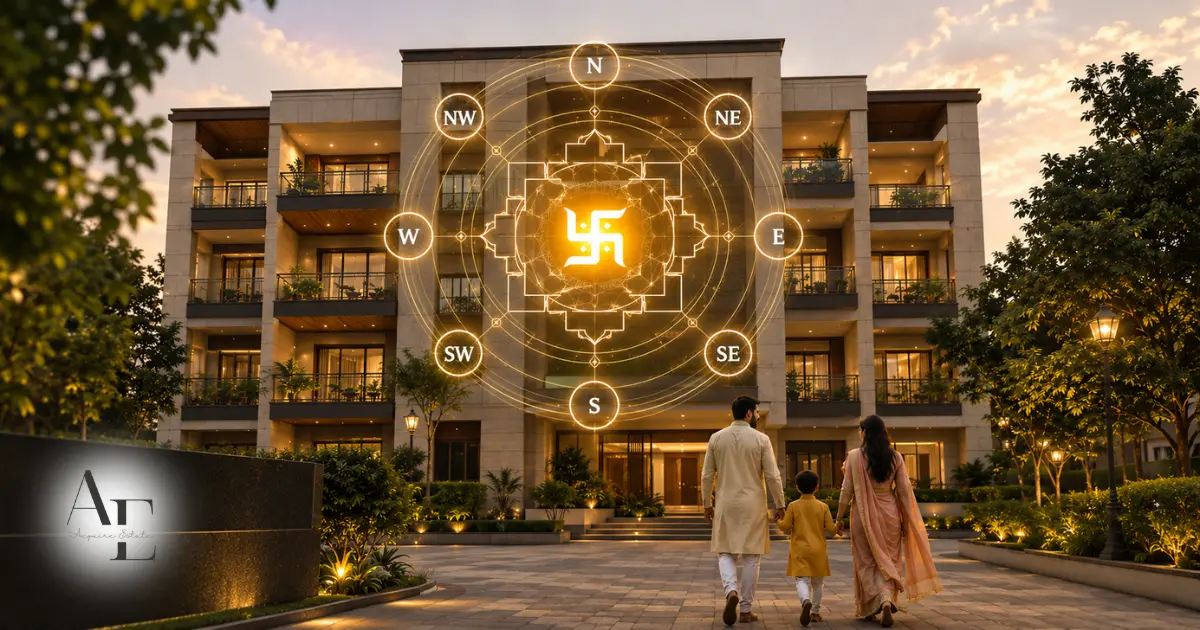
You've finally found the perfect flat. The location works. The price fits. The builder's track record is solid. And then your mother calls.
"Beta, main door ka face ki disha mein hai?"
Just like that, your Vastu journey begins.
If this sounds familiar — or if you know it's coming — you're in the right place. At Acquire Estate, we've spent nearly a decade working with homebuyers across all age groups. We've seen people dismiss Vastu entirely (usually until something goes wrong) and we've seen families transform the energy of their homes with a few thoughtful changes.
This guide isn't about superstition. It's about a time-tested system for energy flow, natural alignment, and creating a home where your family genuinely thrives. We've built it specifically for modern flat buyers — people who are buying pre-constructed homes and need practical guidance, not just theory.
Here's what we'll cover:
Vastu Shastra is not an interior decoration. It is a 5,000-year-old architectural science that aligns your living space with natural forces — sunlight, wind, and magnetic energy — so the environment around you supports rather than drains you.
At its core is the concept of Pancha Bhoota, the five elements of nature:
Element | Sanskrit Name | Direction |
Earth | Prithvi | South-West |
Water | Jal | North-East |
Fire | Agni | South-East |
Air | Vayu | North-West |
Space | Akasha | Centre |
When these five elements are balanced within your home, every aspect of life — health, wealth, relationships, sleep, career — tends to move in a positive direction. When they are disrupted, the imbalance shows up in ways that feel unrelated but often trace back to the energy of the space.
People like Mukesh Ambani, Amitabh Bachchan, and Gautam Adani are known to factor Vastu deeply into the design of their homes and workplaces. This is not coincidence.
Yes — and this distinction matters.
In an independent house, you design everything from scratch. Door directions, room placement, kitchen position — all of it is in your hands.
In a flat, the builder has already made those decisions. The walls are fixed. The door is where it is. The kitchen is where it is.
So Vastu for flats works differently. It focuses on:
Before we go room by room, you need to understand this concept. Almost nobody explains it to flat buyers, but it is the foundation of everything.
Vastu Purusha Mandala is a sacred energy grid. Imagine a human figure lying face down inside a square or rectangle — this is the Vastu Purusha. His head rests in the North-East. His feet are in the South-West. His body covers the entire plot or floor plan.
Every room placement in Vastu is based on this grid. The North-East (his head) must be kept light, clean, and sacred — which is why the pooja room and water sources go there. The South-West (his feet and weight) must be heavy and stable — which is why the master bedroom belongs there.
When you look at your flat's floor plan, mentally overlay this grid. Even if the builder hasn't followed Vastu, knowing where each zone falls helps you decide:
This grid also divides your flat into 16 zones, each governed by a specific deity and element. The most important zone within this grid is the centre — called the Brahmasthan.
If there is one concept that is almost never discussed with flat buyers, it is this one. And it is arguably the most important.
Brahmasthan literally means "the place of Brahma" — the creator. It refers to the central zone of your flat. Think of it as the heart of your home. Just as the heart pumps blood to every organ, the Brahmasthan circulates energy to every room in your flat.
Clear it. Move furniture to the edges. Place a small Swastik symbol or a Vastu pyramid in the exact centre. Keep a bowl of sea salt there, replacing it every 15 days. These remedies alone have made a noticeable difference in many homes.
The main door is the mouth of your home. Energy — good and bad — enters from here first.
The living room is where energy meets people. It should feel light, welcoming, and open.
The kitchen represents Agni — fire — and is one of the most energetically sensitive spaces in your flat. What happens in this room affects the health and prosperity of the entire family.
Your bedroom is not just for sleep. It is where your body and mind recover from the world. Vastu takes this seriously.
The South-West is the ideal corner for the master bedroom because this zone is governed by the Earth element — heavy, stable, grounding. It naturally promotes deep sleep and a sense of security.
Children are deeply influenced by the energy around them. Their room's direction and arrangement affects their concentration, emotional balance, and overall development.
The pooja room is the most energetically charged room in your flat. When placed and maintained correctly, it becomes the source of positive energy for the entire home.
Vastu classifies bathrooms and toilets as spaces of draining or releasing energy. This is not negative by itself — but their placement determines whether this draining energy affects the rest of your flat.
This section is often missing from Vastu guides, but it matters enormously — especially for families with students or professionals working from home.
If you live in a duplex flat or your building has an internal staircase, its position and design matters in Vastu.
Balconies and windows are how natural energy enters your flat. Their direction directly affects the quality and nature of energy circulation inside.
Most flat buyers paint their walls by preference. Vastu adds a layer of intention to this choice. Each direction corresponds to an element, and each element responds to certain colours.
Direction | Element | Ideal Colours |
North-East | Water + Space | White, light blue, cream |
East | Air + Sunlight | Green, light yellow, white |
South-East | Fire | Orange, red, pink |
South | Fire + Earth | Red, orange, brown |
South-West | Earth | Earthy brown, beige, yellow ochre |
West | Water + Air | Blue, white, silver |
North-West | Air | Light grey, white, silver |
North | Water | Green, blue, white |
Centre (Brahmasthan) | Space | White or leave it open/neutral |
You don't need to paint every room a different colour. But being aware of the zone your room falls in — and choosing colours accordingly — makes a significant difference to the energy you feel inside each space.
Here is the honest truth most Vastu guides won't tell you: almost no flat is perfectly Vastu-compliant. The builder designs for space optimisation and budget — not for energy alignment.
But that does not mean you are stuck.
Here are the most effective remedies for common Vastu defects in flats:
For a South-facing main door: Place a Vastu copper strip at the threshold. Hang a 5-rod wind chime inside. Keep the entrance extremely well-lit and welcoming.
For toilet in the North-East: This is serious — don't ignore it. Place a Vastu pyramid inside the toilet, keep the door closed always, hang a small mirror on the inside of the toilet door facing outward, and place sea salt in a bowl inside.
For kitchen in the North-East: Use red or orange accents inside the kitchen to amplify fire energy. Place a small Vastu fire pyramid near the stove. Avoid blue or black colours in this kitchen.
For a blocked Brahmasthan: If furniture or a wall column sits in the centre, place a Vastu pyramid at the exact central point. Keep the floor around it as clear as possible. Use bright overhead lighting in this zone.
For bedroom in the North-East: Use warm, earthy tones. Sleep with your head pointing South. Avoid too much water imagery (paintings, blue colours) in this room as it conflicts with the water element of the zone.
Reading about Vastu is one thing. Getting your flat assessed by someone who genuinely knows what they are looking at is another. Over the years, we at Acquire Estate have seen families try to implement Vastu themselves with mixed results — not because the principles are wrong, but because reading a floor plan through the lens of Vastu requires trained eyes and real experience.
If you are serious about getting a professional consultation for your new flat, here are four names worth knowing:
Based in: Sainik Farms, New Delhi | Consultants available across India
MahaVastu is one of India's leading names in Vastu and Vedic sciences, founded by Dr. Khushdeep Bansal — a researcher who dedicated decades to understanding how directions and elements interact with human behaviour and life outcomes.
Dr. Bansal is the author of what is considered the world's largest book on Vastu Shastra, along with eight other titles on the subject. He is recognised as a foremost consultant and has served as an advisor on several state government projects, and as a strategic consultant to leading businessmen and industrialists.
What makes MahaVastu stand apart from generic Vastu practitioners is its structured framework. In his research on Vedic architecture, Dr. Bansal discovered that directions are governed by three Gunas — Rajas, Satva, and Tamas — within a building, and built an entire diagnostic system around this understanding.
Their services include personalised Vastu consultations and remedies for homes, kitchens, and commercial spaces such as offices and factories. They also offer training programs to become a certified MahaVastu expert, with services intended for both individuals seeking personal guidance and professionals like architects and interior designers.
Best for: Families buying new flats, homeowners dealing with persistent problems related to health, finances, or relationships, and architects wanting Vastu-integrated project planning.
Based in: Delhi | Online and in-person consultations available across India
With over 12 years of experience, Acharya Pankit Goyal has guided more than 12,000 families and clients worldwide, and reached over 3 million people through Instagram, Facebook, and YouTube by sharing practical Vastu insights and remedies. He has also conducted seminars, workshops, and courses to simplify these ancient sciences for the modern homebuyer.
What distinguishes Acharya Pankit Goyal from generic Vastu practitioners is his results-first methodology. Before recommending any change, he conducts a thorough analysis of the client's current challenges, directional orientation, and individual birth chart to provide personalised Vastu solutions that align both the space and the individual.
He is particularly known for making Vastu accessible without making it frightening. His core belief: 80% of Vastu corrections do not require demolition or renovation — smart placement of objects, colours, and functional changes can shift the energy of a space completely.
His specialisation covers both residential and commercial Vastu, with a particular focus on factory and business Vastu, business strategies, and AstroVastu — which combines Vedic astrology with Vastu principles.
Best for: Working professionals, flat buyers on a budget who want practical no-demolition solutions, and entrepreneurs looking to align their business or home office for growth.
Based in: Sector 36B, Chandigarh (Tricity region) Listed on: MahaVastu Expert Network
If you are based in Chandigarh, Mohali, or Panchkula and want an in-person consultation from someone with a strong local presence, Shreel Goyal is a name you will come across.
A certified MahaVastu Expert and Intuitive Acharya, Shreel Goyal's journey into Vastu began from a deeply personal place — as an oil extraction plant owner, he first encountered Vastu when tracing the root cause of a fire accident at his own facility through Vedic Astrology and MahaVastu principles. That experience turned into a calling. He has since trained 245 participants, guided 150 families with Astro-MahaVastu solutions, and helped 250 individuals improve profits and family health.
His consulting covers business issues, family relationships, legal and banking support, improving sales, and money matters — making him a versatile Vastu consultant for both home and commercial clients in the region.
Best for: Tricity residents (Chandigarh, Mohali, Panchkula) looking for a local certified expert with hands-on MahaVastu training and grounded, practical experience.
Specialisation: Residential Vastu, Flat Vastu, Personal Energy Alignment
Acharya Viraj is a Vastu practitioner with a growing presence in the consulting space, known for working closely with residential clients on flat Vastu assessments and directional energy corrections. His approach combines classical Vastu Shastra principles with practical, room-by-room guidance — particularly suited for flat buyers who are navigating pre-constructed layouts and need help working within existing constraints.
His consultations typically begin with a floor plan review, followed by a detailed energy zone assessment, and recommendations that focus on furniture placement, colour corrections, and elemental remedies rather than structural changes. He is accessible for both in-person visits and online consultations for clients across India.
Note: We recommend reaching out directly to confirm current availability, consultation format, and fees before booking.
Best for: New flat buyers wanting a personalised room-by-room Vastu review, families dealing with non-compliant layouts, and homeowners who prefer a thorough one-on-one consultation over a generalised report.
Our ancestors didn't follow Vastu out of superstition. They understood that the spaces we inhabit shape us as much as we shape them. The direction of morning sunlight, the flow of natural air, the grounding effect of the Earth zone under your bedroom — these are not mystical. They are physical realities that affect your body and mind every single day.
You don't need a perfect flat. You need awareness — and the willingness to work with what you have.
At Acquire Estate, we help families across the Tricity (Chandigarh, Mohali, Panchkula) and Punjab find flats that are as Vastu-aligned as possible — and where they're not, we help you understand what you're working with before you sign the papers. You can browse verified, North and East-facing listed properties on our platform or speak directly with our team.
A home is the most personal investment you will ever make. Make it one where your family can truly flourish.
Is Vastu for a flat different from Vastu for an independent house?
Yes, meaningfully so. In an independent house, you design everything — door directions, room placement, staircase position — from the ground up. In a flat, the builder has already fixed all of that. Vastu for flats focuses on working within these constraints using furniture placement, colours, remedies, and intentional object positioning rather than structural changes.
What is Brahmasthan and why does it matter so much?
Brahmasthan is the central zone of your flat — the energetic heart of the home. It circulates energy to every room the way the heart circulates blood to every organ. A blocked, cluttered, or toileted Brahmasthan disrupts energy flow throughout the entire flat and often shows up as unexplained stress, health issues, or financial stagnation in the family.
Which direction is best for the main door as per Vastu?
North, East, and North-East are the most auspicious. North brings magnetic earth energy, East channels morning sunlight, and North-East combines both. South-West is the most problematic and needs active remedies.
Can Vastu remedies fix a non-Vastu-compliant flat?
They can significantly improve it. Remedies won't restructure walls, but the right use of colours, crystals, sea salt, plants, mirrors, pyramids, and copper strips can redirect and rebalance energy very effectively. Most families live comfortably in non-ideal layouts with thoughtful Vastu remedies.
Is a south-facing flat bad as per Vastu?
Not necessarily. It requires more attention and conscious effort to balance — particularly keeping the South-West heavy, the North-East light and open, and the main entrance carefully managed. Many south-facing homes are excellent with the right interior arrangement.
What are the five most important Vastu tips for a new flat?
Keep the entrance clean, bright, and welcoming. Sleep with your head pointing South or East. Place your pooja space in the North-East. Keep the Brahmasthan (centre of the flat) as open and uncluttered as possible. And make sure the kitchen stove and sink are not placed directly beside each other.
Yes, meaningfully so. In an independent house, you design everything — door directions, room placement, staircase position — from the ground up. In a flat, the builder has already fixed all of that. Vastu for flats focuses on working within these constraints using furniture placement, colours, remedies, and intentional object positioning rather than structural changes.
Brahmasthan is the central zone of your flat — the energetic heart of the home. It circulates energy to every room the way the heart circulates blood to every organ. A blocked, cluttered, or toileted Brahmasthan disrupts energy flow throughout the entire flat and often shows up as unexplained stress, health issues, or financial stagnation in the family.
North, East, and North-East are the most auspicious. North brings magnetic earth energy, East channels morning sunlight, and North-East combines both. South-West is the most problematic and needs active remedies.
They can significantly improve it. Remedies won't restructure walls, but the right use of colours, crystals, sea salt, plants, mirrors, pyramids, and copper strips can redirect and rebalance energy very effectively. Most families live comfortably in non-ideal layouts with thoughtful Vastu remedies.
Not necessarily. It requires more attention and conscious effort to balance — particularly keeping the South-West heavy, the North-East light and open, and the main entrance carefully managed. Many south-facing homes are excellent with the right interior arrangement.
Keep the entrance clean, bright, and welcoming. Sleep with your head pointing South or East. Place your pooja space in the North-East. Keep the Brahmasthan (centre of the flat) as open and uncluttered as possible. And make sure the kitchen stove and sink are not placed directly beside each other.
Dreaming of your perfect home in Mohali? Discover powerful home vastu tips, vastu tips for buying new flat, vastu tips f...

Planning to buy a spacious 4 BHK in Zirakpur under ₹3 Cr? This guide covers connectivity to Chandigarh, Mohali and Panch...

The Zirakpur–Panchkula bypass aims to reduce traffic congestion and improve connectivity across the Tricity region. The...