


Buying a Home
4 BHK Flats in Mohali Under 3 Cr & Best Location to Buy
Planning to buy a spacious 4 BHK in Mohali with a budget of up to ₹3 crore? This guide covers the best locations along A...
Punjab RERA 2026 helps homebuyers verify project registration, builder credibility, approvals, payment terms, and possession timelines before buying property in Mohali, Zirakpur,…Punjab RERA 2026 helps homebuyers verify project registration, builder credibility, approvals, payment terms, and possession timelines before buying property in Mohali, Zirakpur, and New Chandigarh.






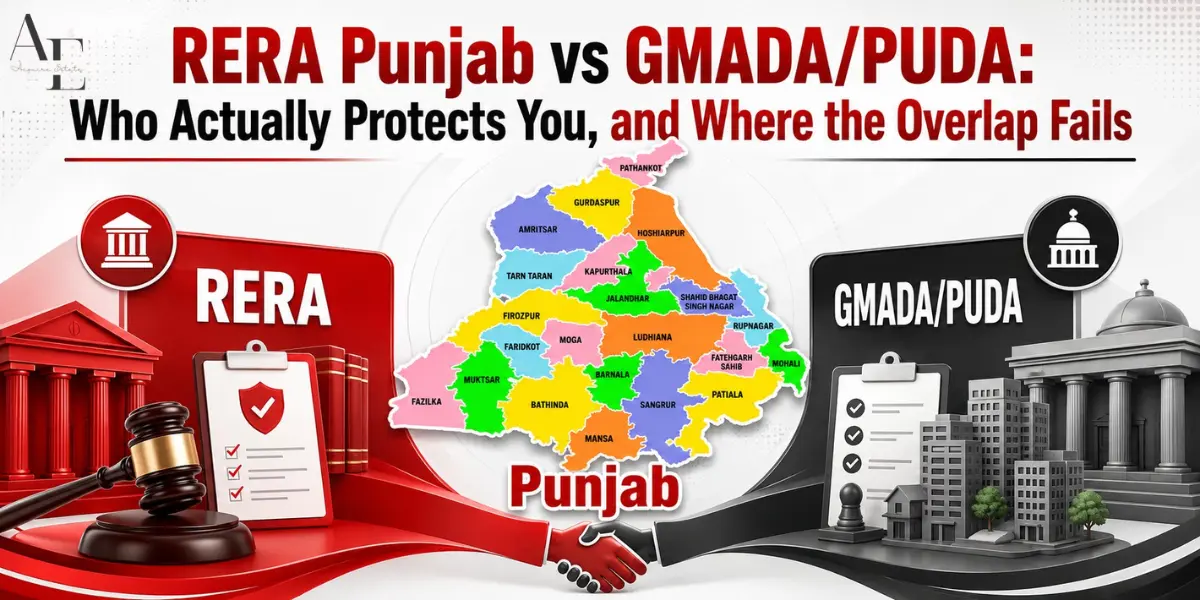
Three authorities. One plot of land. And if something goes wrong, all three can point at each other.
You've heard the names. RERA. PUDA. GMADA. They get thrown around in every property brochure in Mohali, Zirakpur, and Chandigarh's whole tricity belt.
But here's the question almost nobody answers honestly: if your project goes wrong, which one of these actually has your back?
Most buyers assume all three are basically the same thing wearing different hats. They're not. Each one has a different job. Each one has a different jurisdiction. And the gap between their jobs is exactly where thousands of homebuyers have lost money.
This blog breaks down what each authority really does, where their powers overlap, and — more importantly — where they don't overlap at all.
PUDA plans the state. It decides what land becomes a residential sector, a commercial zone, or stays green.
GMADA builds and sells land in the Greater Mohali region specifically. Think Mohali, Zirakpur, Kharar, Derabassi, Banur, and Mullanpur.
RERA Punjab is the referee. It doesn't plan or sell land — it makes sure whoever sells it to you keeps their promises.
One plans. One develops. One protects. Three different jobs, and buyers routinely confuse them until something goes wrong.
Think of PUDA as the architect who never touches a brick.
The Punjab Urban Planning and Development Authority operates under the Department of Housing and Urban Development, Punjab, and its core job is preparing master plans that decide land use, zoning, and infrastructure across the state's urban areas. It's the policy-setting parent body. Regional authorities like GMADA work under the framework PUDA lays down.
If a plot of agricultural land is going to become a residential sector fifteen years from now, PUDA's master plan is where that decision starts.
If PUDA draws the map, GMADA is the one who actually shows up with the bulldozer.
The Greater Mohali Area Development Authority is the regional executor. It was constituted under the Punjab Regional and Town Planning and Development Act, 1995, for the development and redevelopment of Mohali, Banur, Zirakpur, Derabassi, Kharar, Mullanpur.
GMADA acquires land, lays roads and sewage lines, approves building plans, runs e-auctions, and allots plots directly to citizens through schemes and lotteries. When you buy a GMADA plot, you're buying from a government authority, not a private builder — which is a very different risk profile than buying from a private developer registered with RERA.
This is the authority your money actually depends on — yet it's the one buyers understand the least.
RERA Punjab doesn't build anything. It regulates the people who do. Every private promoter — GMADA included, for its own project marketing — has to register a project with RERA before selling a single unit.
Once registered, promoters are legally required to:
As of now, RERA Punjab's own portal lists dt 09/07/206 2,002 registered projects and 4,179 registered real estate agents in the state — a useful benchmark, because if a project you're considering isn't in that list, RERA has zero authority over it. None. That single fact is the root of almost every overlap failure discussed below.
Nationally, the scale of RERA's impact is real: India now hasover 1.43 lakh RERA-registered projects covering 1.11 crore housing units, and roughly 1.38 lakh buyer complaints have been resolved through the RERA system as of 2025. That's the system working as designed — for projects that are actually inside it.
Forget opinions. Here's what the actual data says — and it's more revealing than any brochure will tell you.
| Metric | Figure | Source |
|---|---|---|
| Projects registered with RERA Punjab | 2,002 | RERA Punjab portal |
| Real estate agents registered with RERA Punjab | 4,179 | RERA Punjab portal |
| Mandatory complaint resolution window | 120 days from filing | RERA Punjab regulations |
| Maximum advance a builder can collect before a signed sale agreement | 10% of property cost | RERA Punjab regulations |
| Delay-possession interest owed to buyers | SBI MCLR + 2% | RERA Punjab regulations |
| RERA-registered projects nationally | 1.43 lakh+ | Ministry of Housing & Urban Affairs tracker |
| Housing units covered nationally | 1.11 crore | MoHUA tracker |
| Buyer complaints resolved nationally 2025 | ~1.38 lakh | MoHUA tracker |
| Land reclassified as “delisted” across Punjab | ~55,000 hectares | The Tribune |
Two things jump out. First, Punjab's 2,002 registered projects is a modest number next to states like Uttar Pradesh, which alone has 60,021 registered complaints on the books, against Maharashtra's 34,485— a reminder that Punjab's real estate market, while growing fast around Mohali and Zirakpur, is still smaller and younger than the metros that dominate RERA headlines. Fewer registered projects also means fewer data points for buyers to compare developer track records against, so due diligence has to work harder per project here than it does in Mumbai or Gurugram.
Second, disposal speed varies enormously by state, and that variance matters more than people realize. Nationally, Gurugram's RERA bench has pushed its disposal rate to 93.62% of 17,893 registered complaints, the highest in the country, while Uttar Pradesh sits at 86.71% and Maharashtra at 82.03%. Punjab's own 120-day statutory window for resolving a filed complaint looks fast on paper — but a statutory window only means something if the authority's actual capacity keeps pace with filings as Mohali's tricity market keeps expanding. That's a gap worth watching, not assuming away.
The 55,000-hectare delisted-land figure deserves its own callout, too. That's not a rounding error — it's a landmass large enough to swallow entire townships, now sitting in a regulatory gray zone where neither the old environmental protections nor RERA's escrow-and-registration net automatically apply. Every hectare in that number is a potential plot someone is being sold right now, on the assumption that "government land" and "RERA-protected land" mean the same thing. They don't.
On paper, this system is airtight. Here's the chain that's supposed to protect you at every step.
In theory, the three authorities form a clean chain:
If every project followed this chain, buyers would genuinely be protected end to end. Many organized GMADA sectors and RERA-registered private projects do follow it, and buyers in those projects have real legal recourse.
Now for the part most blogs conveniently skip — because this is where buyers actually get burned.
1. Plotted colonies on "delisted" land slip through every net. In early 2026, GMADA pushed for FIR action against a developer accused of carving illegal colonies — Fairwood Farms and Imperial Golf Greens near Nada, Majri — on land that had been taken out of the Punjab Land Preservation Act's purview, part of nearly 55,000 hectares across the state now classified as "delisted land". Land leaving one regulatory umbrella doesn't automatically place it under another. Buyers assumed "it's near Mohali, so it's covered." It wasn't registered with RERA at all.
2. RERA can only act on what's registered — the overlap collapses at the entry point. RERA Punjab's protection is not automatic; it applies only after a promoter registers. An unregistered plotting scheme, however professionally marketed, sits completely outside RERA's escrow rules, delay penalties, and complaint mechanism. PUDA and GMADA's planning and licensing role doesn't retroactively pull an unregistered seller into RERA's net either — the two systems don't automatically talk to each other from a buyer's side.
3. Jurisdiction confusion between PUDA and GMADA delays accountability. PUDA is the parent authority covering the entire state; GMADA is one of several regional bodies executing PUDA's policy only in the Greater Mohali belt. Outside that belt, other regional development authorities apply. Buyers in fringe areas — where a GMADA sector map ends and a municipal corporation or a different regional authority begins — often can't tell which office is even responsible for their completion certificate or infrastructure complaint.
4. Resale and older colonies fall into a regulatory blind spot. RERA largely governs new project sales, not resale transactions or colonies developed before May 2017. If a colony was regularized by GMADA years ago but never separately registered with RERA, buyers today have essentially no RERA cover, only whatever GMADA's own regularization terms provide.
Five minutes of checking now can save you five years of litigation later.
For a step-by-step walkthrough of filing a complaint once you've confirmed registration, see our detailed guide on how to file a RERA Punjab complaint. If you're specifically evaluating a Mohali-region plot, our GMADA plot verificationchecklist walks through the extra due diligence layer this article recommends.
The questions every buyer asks eventually — better to ask them before you sign, not after.
No. GMADA is the seller or land-developing authority; RERA is a separate regulatory layer. A GMADA project still needs its own RERA registration for escrow protection and delay penalties to apply.
PUDA is the state-level planning parent body covering all of Punjab. GMADA is a regional authority that executes development specifically within the Greater Mohali area, operating under the framework PUDA and the state government set.
RERA can penalize the promoter for failing to register and can direct buyers toward complaint mechanisms, but the strong buyer protections — escrow accounts, delay interest, carpet-area billing — only apply cleanly to registered projects.
This isn't disclosed by default in most marketing material. Ask the developer directly for documentation and cross-check with GMADA or the district town planner's office, since delisting status affects both environmental compliance and RERA applicability.
Largely, yes. RERA's core protections are strongest for first-sale, registered projects. Resale buyers should lean more heavily on GMADA/PUDA completion certificates and title verification instead.
RERA Punjab, GMADA, and PUDA aren't redundant — they're sequential. Planning, development, and protection are three separate jobs, and the buyer protection only kicks in at the last link of that chain. The moment a project skips proper registration, or sits on land whose classification changed quietly, the overlap that's supposed to protect you simply isn't there.
The safest move isn't trusting one authority's name on a brochure. It's checking all three, in order, before you sign anything.
Because in Punjab real estate, the fine print isn't in your sale agreement. It's in the gap between three government offices.
Planning to buy a spacious 4 BHK in Mohali with a budget of up to ₹3 crore? This guide covers the best locations along A...

GB Realty has officially taken over the Downtown Mohali commercial project in Sector 62, bringing RERA-approved shops, s...

Confused by real estate terms like carpet area, FAR, stamp duty and hypothecation? This 2026 guide from Acquire Estate b...