

Hi there! How can we help you today?

Buying a Home
4 BHK Flats in Mohali Under 3 Cr & Best Location to Buy
Planning to buy a spacious 4 BHK in Mohali with a budget of up to ₹3 crore? This guide covers the best locations along A...
Confused by real estate terms like carpet area, FAR, stamp duty and hypothecation? This 2026 guide from Acquire Estate breaks down every…Confused by real estate terms like carpet area, FAR, stamp duty and hypothecation? This 2026 guide from Acquire Estate breaks down every term in simple language, with real Tricity examples, verified government rates and quick tables you can use before signing your next property deal.







Buying a home is exciting. But real estate terms in the paperwork can turn that excitement into confusion within minutes. A buyer in Zirakpur once told us he signed his flat agreement without understanding half the real estate terms written inside it.
He found out about extra charges only after possession. This happens more often than people admit. Every month, buyers across Mohali, Kharar, Panchkula and New Chandigarh sign documents without knowing what carpet area, FAR or collector rate actually mean? A little knowledge here can save you lakhs and a lot of stress later.
This guide breaks down the real estate terms you will meet during any property purchase in 2026. No confusing legal language. Just simple answers you can actually use before you sign.
Property paperwork is full of similar-sounding words. Carpet area and super area sound almost the same. But actually they are not.
One buyer we spoke to in Zirakpur paid for 1,300 square feet. His actual usable space was only 950 square feet. Nobody cheated on him. He simply did not know the difference.
That single misunderstanding cost him lakhs in extra payment and months of quiet regret every time he measured his own living room.
This is why understanding these terms is not optional anymore. It is basic financial safety, the same way checking an expiry date is basic health safety.
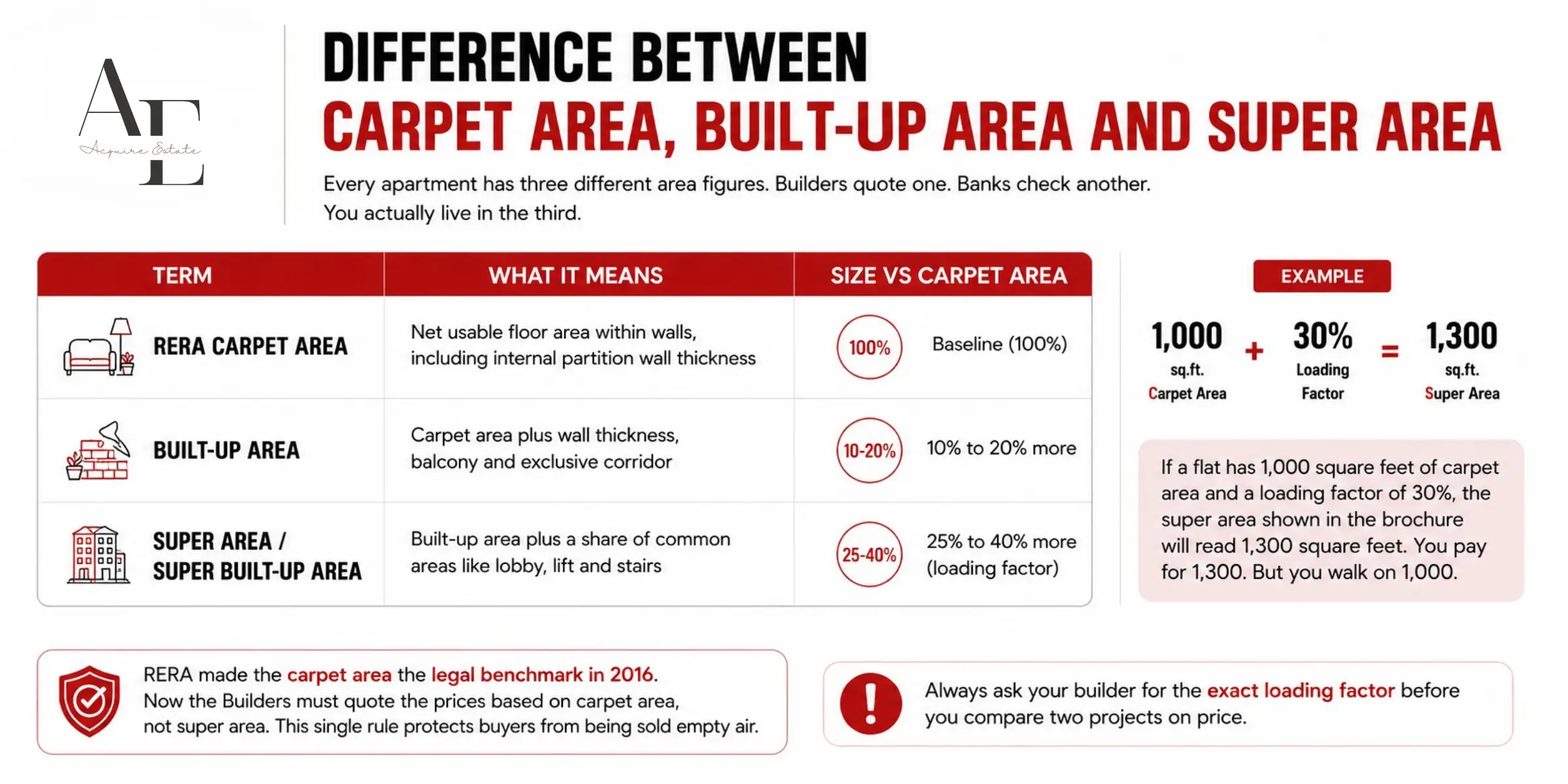
Every apartment has three different area figures. Builders quote one. Banks check another. You actually live in the third.
What Are You Really Paying For?
Term | What It Means | Size vs Carpet Area |
RERA Carpet Area | Net usable floor area within walls, including internal partition wall thickness | Baseline (100%) |
Built-Up Area | Carpet area plus wall thickness, balcony and exclusive corridor | 10% to 20% more |
Super Area / Super Built-Up Area | Built-up area plus a share of common areas like lobby, lift and stairs | 25% to 40% more (loading factor) |
RERA made the carpet area the legal benchmark in 2016
Here is a simple way to remember it. If a flat has 1,000 square feet of carpet area and a loading factor of 30 percent, the super area shown in the brochure will read 1,300 square feet. You pay for 1,300. But you walk on 1,000. Always ask your builder for the exact loading factor before you compare two projects on price.
FAR or Floor Area Ratio, decides how much construction is allowed on a plot. It is also called FSI or Floor Space Index, in some states. The two mean the same thing, just written differently.
The formula is simple. Total built-up area allowed equals plot area multiplied by FAR. Suppose a plot is of 1,000 square feet with an FAR of 2.0 permits 2,000 square feet of total construction across all floors.
Local development authorities like GMADA set the FAR limits differently for each zone. A higher FAR usually means more units on the same land.
That can mean better shared amenities per resident or a more crowded project, depending on how the builder uses that extra space.
Always ask your builder what FAR their project was approved under. It quietly tells you how dense your future neighbourhood will actually feel, long before you move in.
These three documents get confused constantly, yet they mean very different things.
Document | What It Does | When It Applies |
Agreement to Sell | A promise to sell once agreed conditions are met. It does not transfer ownership. | Before final payment or registry |
Sale Deed | The actual, registered document that transfers ownership to the buyer. | At possession and registry stage |
Buyer Builder Agreement | Covers price, payment schedule, possession date, specifications and penalties. | At booking, under-construction units |
The clause nobody reads carefully is usually the one that costs the most. Payment schedules, penalty clauses for delayed possession and specification details in a Buyer Builder Agreement deserve a slow, careful read. Not a quick signature at the sales office, while someone waits to shake your hand.
A triparty or tripartite agreement brings three parties into one contract. The buyer, the bank and the builder.
Here is why it exists. When you buy an under-construction flat with a home loan, you are not yet the legal owner. The bank cannot simply hand you money against a flat that does not exist yet. So the builder joins the agreement too, promising to hand over an encumbrance-free flat once construction finishes.
This agreement protects everyone at once. The bank gets security. The builder gets staged payments tied to actual progress. You get a documented promise that your hard-earned money is going exactly where it should.
Buyers often assume possession and registry are the same event. But they are not and confusing the two can quietly cost you your legal ownership rights.
Possession means the builder hands you the keys. You can move your furniture in. Registry means the sale deed is legally recorded at the Sub-Registrar office and stamp duty is paid in full. Only after registry are you the recorded legal owner in government land records.
Taking possession without completing a registry is risky. Your name is nowhere in official records. Disputes, resale and even loan closure become harder without a registered sale deed. Always push for registry within a reasonable time after possession, not months or years later, however busy life gets.
Stamp duty is the tax you pay to the state government to make your sale deed legally valid. In Punjab, the current rates are straightforward. Stamp duty and registration charges in Punjab 2026 are as follows:
Buyer Category | Stamp Duty | Registration Fee |
Male buyer | 7% | 1% |
Female buyer | 5% | 1% |
Joint (male + female) | 6% | 1% |
Cooperative housing society (Jan 2026 relief window) | As low as 1% | 1% |
For example, on a property worth Rs. 75,00,000, a male buyer pays roughly Rs. 5,25,000 as stamp duty plus Rs. 75,000 as registration, totalling Rs. 6,00,000. A female buyer on the same property pays two percent less stamp duty, a real saving worth planning around.
Punjab announced a major relief in January 2026 for buyers in registered cooperative housing societies. Many long-pending registrations in Mohali, Zirakpur and Kharar can now be completed at a stamp duty as low as 1 percent, within a specified window. This has genuinely changed the maths for hundreds of families who had delayed their registry for years out of sheer cost.
Collector rate, also called circle rate, is the minimum value the government has set for property in a specific locality. Your registry cannot be done below this value, even if you negotiated a lower price with the seller.
According to a Tribune India report, the Punjab government has hiked collector rates in major cities. Collector rates vary sharply between sectors in Mohali, Zirakpur and Panchkula, so always check the current rate for your exact locality before budgeting your registration cost.
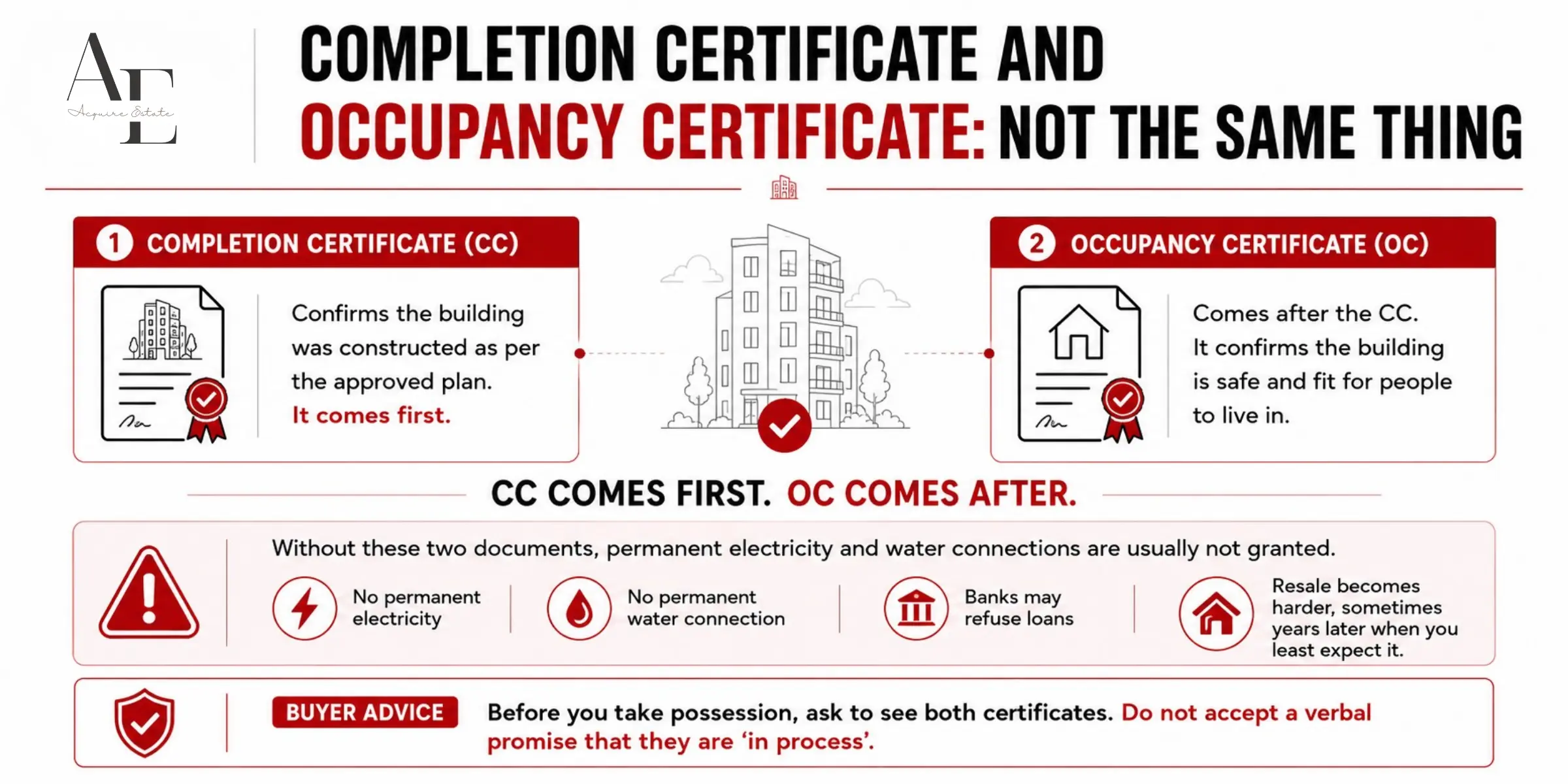
A Completion Certificate or CC, confirms the building was constructed as per the approved plan. It comes first.
An Occupancy Certificate or OC, comes after the CC. It confirms the building is safe and genuinely fit for people to live in.
Without these two documents, permanent electricity and water connections are usually not granted. Banks may refuse loans. Resale becomes harder, sometimes years later when you least expect it. Before you take possession, ask to see both certificates. Do not accept a verbal promise that they are "in process."
Hypothecation means your property is pledged or kept as security for a loan, while you continue to hold the ownership. The lender does not own your flat. But if you default on payments, the lender has the first legal right to recover dues from that property.
This is different from simply owning a mortgaged home outright. Until your loan is fully repaid, the property carries this charge in bank records. This charge must be formally cleared before you can sell the property with a clean, undisputed title.
NEC stands for Non-Encumbrance Certificate. It is issued by the Sub-Registrar's office and confirms that a property carries no pending loan, mortgage or legal claim during a specified period.
Banks almost always ask for an NEC before approving a home loan. Buyers should ask for one before finalising any resale deal too. A clean NEC means the property you are about to pay for is truly free of hidden financial baggage, the kind that surfaces only after it is too late.
Term | Meaning in One Line |
Carpet Area | Usable floor area within your walls |
Built-Up Area | Carpet area plus walls and balcony |
Super Area | Built-up area plus a share of common spaces |
FAR / FSI | Ratio deciding how much can be built on a plot |
Agreement to Sell | Promise to sell, not a transfer of ownership |
Sale Deed | Registered document that transfers ownership |
Buyer Builder Agreement | Contract with the developer for an under-construction unit |
Tripartite Agreement | Three-way contract between buyer, bank and builder |
Possession | Builder hands over the keys |
Registry | Legal recording of ownership at the Sub-Registrar office |
Stamp Duty | Tax paid to the state to validate the sale deed |
Collector Rate | Government's minimum property value for an area |
Completion Certificate | Confirms construction matches the approved plan |
Occupancy Certificate | Confirms the building is safe to live in |
Hypothecation | Property pledged as loan security while you keep ownership |
NEC | Certificate proving a property has no pending loans or claims |
Prices across the corridor have been climbing fast, especially after the Chandigarh Residential Plot E-Auction 2026 pushed reserve rates 148% above the collector rate and reset benchmarks across the entire Tricity.
The terms can feel like a foreign language when you are signing your first property deal. But once you understand these real estate terms, you stop depending on someone else to explain your own paperwork to you.
At Acquire Estate, we believe every buyer across the Tricity region deserves plain answers, not confusing real estate terms wrapped in legal technical language.
Whether you are exploring options in Mohali, Zirakpur, Panchkula or New Chandigarh, talk to our team before you sign anything. We will walk you through every one of these real estate terms, verify your documents and connect you directly with trusted, verified developers.
Call Acquire Estate: 7837393955
Disclaimer: Stamp duty, registration and collector rate figures reflect Punjab government notifications available as of 2026 and are subject to periodic revision. Buyers should verify current rates with the Sub-Registrar's office or an advocate before finalising any transaction.
The carpet area is the usable floor space within your walls. Super area adds a share of common spaces like the lobby and lift, usually 25% to 40% more.
FAR, or Floor Area Ratio, decides how much total construction is allowed on a plot. It is the same as FSI, just expressed differently.
No. Possession means getting the keys. Registry means your ownership is legally recorded at the Sub-Registrar office after stamp duty is paid.
Male buyers pay 7%, female buyers pay 5%, and joint owners pay 6%, plus a flat 1% registration fee.
It is a three-way contract between the buyer, the bank, and the builder, used when a loan funds an under-construction property.
An NEC proves your property has no pending loan, mortgage, or legal claim. Banks require it before approving a home loan.
Planning to buy a spacious 4 BHK in Mohali with a budget of up to ₹3 crore? This guide covers the best locations along A...

Acquire Estate app connects builders and buyers across the Tricity region with verified listings, genuine leads and zero...

Punjab RERA 2026 helps homebuyers verify project registration, builder credibility, approvals, payment terms, and posses...
Hi there! How can we help you today?