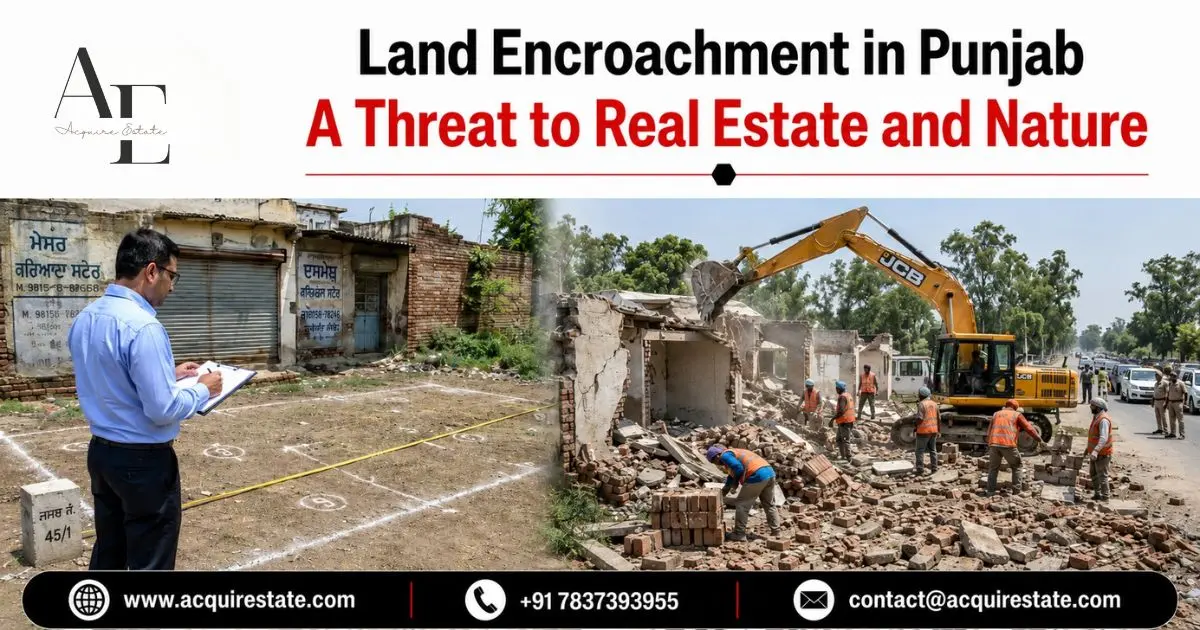
Land encroachment in Punjab is a pressing issue nowadays. The land of five rivers that once fed the entire nation and earned the title of Granary of India is currently reeling under the heatwave of this issue.
Today, thousands of acres of public land in Punjab are illegally occupied. Most of the panchayat lands have been grabbed by powerful individuals. Village common lands are sold off by builders. Floodplains are built over. Wetlands are shrinking. And young families are buying homes in colonies that have no legal standing.
This is not someone else’s problem. This is your own problem If you or your family live in Punjab.
Understanding Land Encroachment in Punjab
Land encroachment means occupying public or government land without any legal right. In Punjab, this illegal occupation covers a wide range of land types. It includes panchayat land, shamlat land (village common land), forest land, wetland buffers, floodplain zones, village ponds, drainage channels, and public open spaces.
The scale is going up!
As per the Comptroller and Auditor General of India’s Report No. 1 of 2026, the most authoritative government audit available reveals that 18,123 acres of panchayat land in Punjab were under unauthorised occupation as of May 2023.
The same report confirms that Punjab’s Panchayati Raj Institutions hold approximately 7.21 lakh acres of shamlat (common) land meant for village welfare and public use. A significant chunk of this land has been under illegal possession for decades.
The CAG also found Rs 9.64 crore in recoverable rent from tenants of panchayat properties that was never collected. It flagged Rs 63.33 lakh in irregular utilisation of land sale proceeds. These are not just accounting errors. They show how deeply the system has failed to protect the land from encroachment.
And the problem runs even deeper at the local level. The Tribune reported that in Mohali alone, around 15,000 acres of panchayat land were grabbed by politicians, bureaucrats, police officers, and builders — many of whom had built private farmhouses and commercial colonies on these public lands. In Jalandhar, 672 acres of shamlat land across 30 villages were under illegal occupation, as confirmed by the Panchayat Department. In SAS Nagar, encroachments spread across 3,469 acres. In Patiala, over 1,100 acres were in illegal possession.
These are not just numbers. These are fields, ponds, drainage channels, and green commons that should have been yours.
The People Behind the Encroachment
Land encroachment in Punjab is not always the work of poor or desperate individuals. Much of it is organised, deliberate, and politically protected.
When the anti-encroachment campaign was launched in 2022, the Punjab Rural Development and Panchayat Minister identified nearly 25,000 acres under illegal VIP occupation. Of these, 15,000 acres were in Mohali alone. The rest were spread across Ludhiana, Jalandhar, and Amritsar — typically near municipal limits where land had commercial value.
In Majrian village, an investigation was launched into the alleged illegal sale of 2,714 acres of shamlat land. In Seonkh village, over 1,000 acres of common land were investigated for similar reasons. In Hoshiarpur’s Dadyal village, 850 acres of encroached panchayat land were recovered. It was the second-largest single recovery in the state at that time.
At the same time, ordinary village residents also face the consequences. In a recent case from Patiala, Dalit families reported a social and economic boycott after demanding their legal rights over 115 acres of shamlat land. This shows that land encroachment is also a social justice issue. The people most dependent on common land are often the last to get it back.
The Government Drive to Reclaim Land: Progress and Gaps
To its credit, the current Punjab government launched a systematic anti-encroachment campaign starting in 2022.
According to the Punjab Rural Development and Panchayats Department, 12,809 acres of panchayat land had been reclaimed by the end of 2024. The estimated market value of this recovered land is over Rs 3,080 crore. Around 6,000 acres of that recovered land was leased out, generating Rs 10.76 crore in annual income in 2024-25. The department also auctioned 1.36 lakh acres of shamlat land in 2024-25, earning Rs 469 crore for local bodies.
These are real achievements. But they also reveal how much revenue was being lost every year while encroachments went unchallenged.
The gap between targets and results is also telling. A Hindustan Times report said the Panchayat Department reclaimed only 585 acres in 2024 against a target of 10,000 acres. That means only 5.85 percent of the annual target was met — reportedly due to election-related disruption and administrative delays.
What was reclaimed was always a fraction of what was encroached.
The Punjab CAG data shows that panchayat land auctions generated Rs 382.80 crore in 2021-22 and Rs 409.37 crore in 2022-23. Every year that common land stays under illegal occupation, this kind of public revenue is simply lost. It is the revenue that should be paying for your village’s roads, drains, ponds, schools, and streetlights.
The Illegal Colony Problem: When Your Home Sits on Shaky Ground
You may have bought a plot. You may have paid lakhs. But do you know if that colony was ever legally approved?
Punjab has over 30,000 illegal or unauthorised colonies, according to The Tribune. The state’s own Chief Minister acknowledged at least 14,000 such colonies when the Punjab Apartment and Property Regulation Amendment Act was introduced in September 2024.
These are colonies that were developed without the following mandatory approvals:
- Layout plans.
- Environmental clearance.
- Drainage systems.
- Sewage infrastructure.
- Proper road access.
Finance Minister Harpal Singh Cheema admitted publicly that these colonies were developed without basic civic amenities such as water supply, sewage, and proper roads.
This is exactly where a trusted real estate platformin tricity Punjab or Acquire Estate legal property platform can help you understand whether the property is safe, approved, and suitable for long-term investment.
You may face difficulty getting the following:
- Property registration.
- A home loan.
- A resale buyer.
- A clear title.
- Proper sewage.
- Proper stormwater drainage
- You may be vulnerable to the following.
- Flooding because of heavy rain.
The risk of demolition action or penalty.
What is more important is the risk of paying for infrastructure that the government will eventually have to build at political cost once political pressure forces regularisation.
The 2024 PAPRA amendment gave some relief to plot holders of up to 500 square yards in unauthorised colonies by waiving the NOC requirement. But in March 2025, the Punjab and Haryana High Court directed the state to ensure compliance with NOC requirements under the act. That relief is now legally uncertain again.
The Ludhiana case is a warning for all of Punjab. A Times of India report published under the title “Trashing City’s Blueprint” describes how illegal colonies are making the city’s planned expansion impossible by the following:
- Bypassing CLU (Change of Land Use) approvals.
- Overburdening existing drainage.
When you buy into an unauthorised colony, you are not just taking a legal risk. You are funding a system that is destroying the city around you.
How Land Encroachment Is Hitting Businesses and the Local Economy
It is not just a housing problem. It is an economic one.
When panchayat and shamlat lands are under illegal occupation, village panchayats lose the rental and auction income that those lands would have generated. The CAG data shows that this income runs into hundreds of crores annually when land is legally managed. That lost revenue means villages go without maintained roads, functional drains, lit streets, and basic public services.
For businesses, the playing field becomes unfair. Illegal colonies and commercial structures built on encroached land avoid following:
- Development charges.
- Environmental safeguards.
- Layout approvals.
- Infrastructure costs.
All genuine developers and builders who follow the rules bear all those costs and cannot compete on price.
The Ludhiana example showed developers complaining directly about this. They pointed out that illegal colonies were bypassing official planning mechanisms, making it impossible for legitimate real estate to compete.
This is not just bad for business ethics. It is bad for your city’s future.
Land Encroachment and Its Four-Way Impact on the Environment
This is where the alarm must get loudest.
From illegally grabbed panchayat lands, the unauthorised colonies, to the encroached floodplains and wetlands, everything is producing an environmental disaster that is already costing Punjab its natural resources and resilience. And you are already living with its consequences.
The Flood Connection:
The 2025 floods in Punjab are an example of it. That’s the worst water invasion the state has seen in nearly four decades.
Over 3.54 lakh people were affected. More than 1,48,000 hectares of agricultural land were submerged, and Paddy crops were destroyed across 1,400 villages in all 23 districts, said Hardeep Singh Mundian, Revenue Minister, Punjab.
ReliefWeb’s secondary data report put the figure even higher. You will be surprised to know that nearly 20 lakh people were affected across 2,050 villages by September 8, 2025. The Telegraph reported crop damage across 1.75 lakh hectares and 46 deaths.
What Reports Say About It?
Why Did This Happen? This is the first thing that needs to be understood.
Heavy rain was one reason. But experts and official analysis pointed to something else just as clearly.
Down To Earth Report:
Down To Earth identified floodplain encroachment and obstruction of natural drainage as central causes of the 2025 disaster.
Mongabay India Report:
Mongabay India quoted environmentalist Jaskirat Singh directly: “The illegal sand mining in and along the rivers, encroachments over river floodplains and other natural water bodies, and failure in strengthening the bundhs after floods of 2023 resulted in worsening the situation.
When you build on a floodplain, you take away the river’s room to breathe. When you fill drainage channels with concrete, rainwater has nowhere to go. When you remove wetlands to build a colony, you destroy the natural sponge that was absorbing the excess.
Water always takes back its land. It doesn’t matter whether you give it back or not. If you don’t give water its way back, it then makes its own way. Your ancestors knew it very well. This is the reason they never messed up nature in any way.
Coming back to the point, Punjab recorded 443 mm of rainfall up to August 30, 2025. At least 24 percent above the seasonal average. That rain should have spread across wetlands, floodplains, and open land. Instead, it rushed through an encroached, concreted, drainage-blocked landscape and devastated villages.
Warning By The National Green Tribunal
The National Green Tribunal had flagged encroachment on the Sutlej floodplain long before the floods. It had fined government officials for failing to disclose information on offenders. The warnings were there. But the action was not taken at all.
In Gurdaspur alone, ICAR reported that 60,000 hectares of agricultural land were submerged. Sand and silt deposits of 1 to 3 feet were left behind.
In the worst blocks, over 90 percent of the cultivated area was damaged. Rabi wheat sowing was put at direct risk. It is exactly the crop that feeds the nation.
Silt accumulation in rivers caused by encroachment also reduces reservoir capacity. The Gobind Sagar reservoir of the Bhakra Dam lost 25 percent of its capacity to silt accumulation during the 2025 floods, confirms the Bhakhra Beas Management Board’s own statement.
The floods of 2025 were not just a natural disaster. Instead, you can call the catastrophe humans have invited through landencroachment.
Even Our Wetlands Are Dying:
Punjab’s Harike, Kanjali, Ropar, and Keshopur wetlands are internationally recognised Ramsar sites. They are not just bird sanctuaries. They are our state’s natural flood buffers, groundwater recharge zones, and biodiversity lifelines.
Encroachment Is Killing Them One Acre At A Time.
These wetlands have international status. But a large part of these had already been illegally occupied by the influentials, said Balbir Singh Seechewal, Environmentalist and NGT panel member, on the occasion of World Wetlands Day. He called them “on their last breath due to pollution and illegal encroachment
Kanjali Wetland:
Kanjali Wetland near Kapurthala is a 183-hectare Ramsar site declared in 2002. In May 2025, INTACH described it as in a state of “neglect” and said that the government’s failure to regulate encroachments had “brought the wetland to the brink.” INTACH called for an ecological emergency to be declared for Kanjali.
Harike Wetland:
At Harike Wetland in Tarn Taran, one of the largest man-made wetlands in India, migratory bird numbers tell the story of ecological collapse. In 2019-20, Harike hosted 1,23,128 birds across 83 species. By 2023, that had fallen to 65,624. By 2025, it was around 50,000.
The January 2026 Asian Waterbird Census by the Punjab Forest Department recorded a further fall to 52,707. The Tribune noted that persistent encroachment, illegal fishing, and poaching had discouraged birds from settling.
'These birds come from Siberia, Central Asia, and Europe. They arrive in Punjab because they have nowhere else to go. When your wetlands shrink, their journey ends in silence.
Our Groundwater Is Reducing Faster
Punjab’s groundwater extraction rate is 156.87 percent — the highest in all of India, according to a Times of India report citing Central Ground Water Board data. You are pulling out nearly 57 percent more water than nature is putting back. Over 75 percent of Punjab’s administrative blocks are classified as overexploited.
The situation has been getting worse every decade. Districts with groundwater levels deeper than 40 metres increased from just 3 in 2014 to 11 in 2024. The Central Groundwater Board has warned that at the current rate, usable groundwater in Punjab could disappear within 22 years.
Land Encroachment Is Directly Worsening This Crisis. Here Is Why.
Ponds, open fields, wetlands, and village commons act as natural recharge zones. When rain falls on open land, it slowly seeps into the ground and refills aquifers. When that same land is covered with concrete, brick, and packed soil by an illegal colony or encroachment, rainwater cannot enter the ground. It becomes surface runoff — contributing to flooding rather than recharging the water table.
ScienceDirect researchers confirmed that declining groundwater levels in Punjab are “threatening environmental sustainability by diminishing wetlands, reducing base flow to rivers, degrading water quality, and reducing soil moisture.
The relationship works in both directions. Encroachment causes groundwater to deplete faster. Depleting groundwater causes wetlands to dry up further. And drying wetlands increases the damage from floods. It is a cycle you did not start. But your generation will pay for it.
Soil Degradation:
Punjab covers only 1.5 percent of India’s geographical area, yet contributes 35.5 percent of its wheat and 25.5 percent of its paddy to the national food pool. All in all, Punjab’s soil is one of the most productive in the world so far. However, land encroachment is degrading the quality of Punjab’s soil systematically.
Land Encroachment Is Damaging This Soil In Multiple Ways:
When natural vegetation on panchayat or forest land is cleared and replaced with unauthorised structures, the soil loses its capacity to hold water and nutrients. Organic matter disappears. Erosion accelerates. The land’s biological health deteriorates.
The 2025 floods made visible what encroachment has been quietly doing for years. ICAR documented silt and sand deposits of up to 3 feet left behind on agricultural fields in Gurdaspur. Fertile topsoil was buried. Fields that had been productive for generations were left barren.
Illegal colonies without sewage systems dump untreated waste directly into the ground. This contaminates soil with heavy metals, pathogens, and chemicals. Rivers like the Sutlej and Beas are already heavily polluted with industrial and agricultural discharge. Encroachment-driven sewage adds to that load.
The soil that feeds you is not limitless. Every acre of encroached land that is concreted, misused, or contaminated is a subtraction from Punjab’s food security future.
The Legal Framework And What It Demands:
Punjab has laws to deal with this problem. The Punjab Village Common Lands (Regulation) Act of 1961 is the primary law protecting shamlat and common village lands. The Punjab Public Premises Land (Eviction and Rent Recovery) Act, 1973, allows eviction of encroachers from panchayat land through official proceedings.
The Supreme Court, in Dalip Ram v. State of Punjab, decided on 2 January 2025, upheld eviction orders for a person continuing to occupy shamlat land after the expiry of their lease. The court made clear that no occupant has the right to remain on public land once their legal entitlement has ended.
The PAPRA Amendment of 2024 introduced imprisonment of 5 to 10 years and fines of Rs 25 lakh to Rs 5 crore for developers of unauthorised colonies.
The laws are there. The courts are supporting them. The question is whether enforcement keeps up.
The Response Is Happening. But Is It Enough?
The Punjab government’s anti-encroachment campaign has produced real results. 12,809 acres reclaimed. Rs 469 crore in shamlat land auctions. Rs 10.76 crore in annual income from leased recovered land.
But the CAG report still records 18,123 acres under unauthorised occupation. Illegal colonies have grown from 14,000 to over 30,000 across Punjab. In 2024, only 585 acres were recovered against a target of 10,000. Wetlands remain encroached. Floodplains remain occupied. And the 2025 floods showed what happens when encroachment goes unchecked for too long.
The response is happening. It is just not happening fast enough.
What Needs to Change: A Practical Way Forward:
Here is what should be done.
Complete digital mapping of all government land**: Every acre of panchayat, forest, and wetland land must be geo-tagged, digitised, and linked to the Punjab Jamabandi portal. Any unauthorised use should trigger an automatic alert. You cannot protect what you cannot see.
Strict floodplain buffer zones should be created:
The state must officially notify floodplain zones for all five rivers and prohibit construction within defined buffers. This is not an environmental luxury. It is a flood prevention necessity. Every home built on a floodplain is a home in danger.
Ecological Emergency For Threatened Wetlands:
Kanjali, Harike, Ropar, and Keshopur need dedicated protection officers and resident community watchdog committees. INTACH’s recommendation for an emergency declaration at Kanjali must be taken seriously.
Zero Tolerance For New Illegal Colonies Must Be Implemented:
The 2024 PAPRA Amendment penalties of 5 to 10 years in prison are strong on paper. They must be enforced consistently. Every new illegal colony that is allowed to operate becomes tomorrow’s regularisation demand.
Use recovered land for recharge and green cover**: Recovered panchayat land must not sit idle. It should be used for the following:
- Restore Village Ponds
- Plant trees on it
- Restore drainage channels.
This will directly help recharge groundwater and buffer future floods.
For every buyer, investor, NRI, and family planning to purchase property, the message is simple: never buy blindly. Check the ownership. Verify the approvals. Understand the colony status. Study the drainage and flood-risk profile. Work with reliable professionals who value legal safety over quick sales. Acquire Estate stands for informed property decisions, transparent guidance, and secure property investment in Punjab.
Conclusion
Land encroachment in Punjab is stealing from three directions at once.
It is stealing from your generation:
It is trapping your young family in illegal colonies without safe housing, legal security, and basic infrastructure. What is more important is stealing from your economy. It is diverting public land revenue away from roads, drains, and schools that your village needs.
More importantly, land encroachment is ruining the entire Punjab’s future by destroying the natural environment by destroying the floodplains, wetlands, groundwater, and fertile soil.
The CAG has recorded it. The NGT has flagged it. The Supreme Court has upheld evictions. The government has begun reclaiming land. But 18,123 acres remain illegally occupied. Over 30,000 unauthorised colonies are still in existence.
Harike’s birds are declining. Kanjali is on the brink. The water table is falling. And the worst floods in 40 years have already arrived.
Punjab’s rivers — the Sutlej, Beas, and Ravi — are not just water sources. They are the identity of this land. Every floodplain that is encroached, every wetland that shrinks, every village pond that is filled is one step closer to a Punjab destroyed systematically.
If something is not done to prevent this problem, the state will soon reach the point where food will be a luxury people won’t be able to afford. The soil of this land will not be able to hold the water.
What is more important is that the state will not be able to protect its people from catastrophes like floods.
Planning to buy property in Punjab or Mohali? Make sure your investment is legally safe, properly verified, and future-ready. Connect with Acquire Estate for trusted real estate guidance, approved property options, and professional consultation for safe property investment in Punjab.