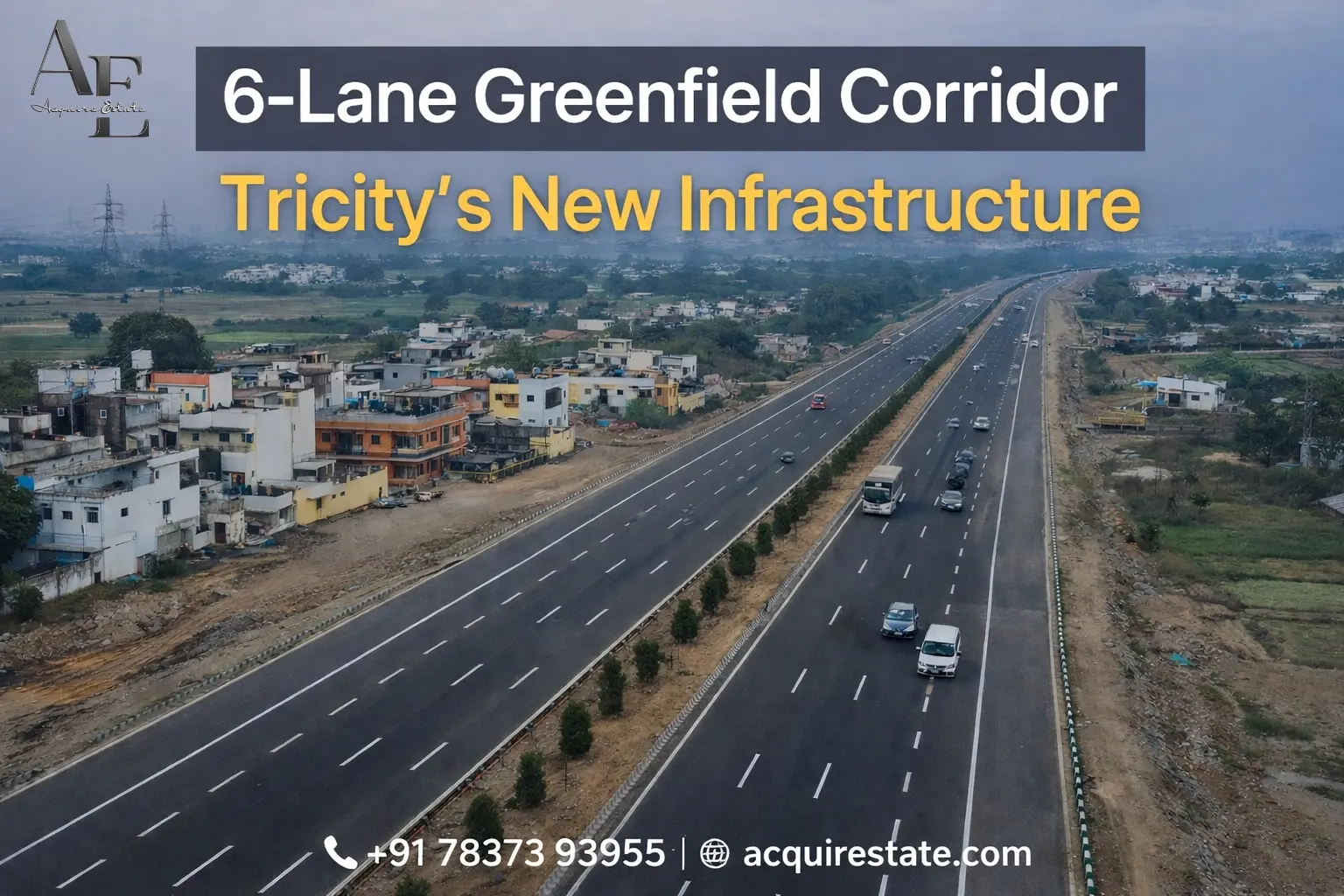
Tricity Infrastructure Update 2026: 6-Lane Greenfield Express Corridor to Ease Traffic & Boost Development
The ₹1,463.95 cr Tricity Greenfield Corridor will create a 6-lane access-controlled expressway linking NH-205A with Zirakpur Bypass, decongest traffic and power regional…The ₹1,463.95 cr Tricity Greenfield Corridor will create a 6-lane access-controlled expressway linking NH-205A with Zirakpur Bypass, decongest traffic and power regional growth.
Chandigarh’s Tricity - comprising Chandigarh, Mohali, and Panchkula - has long grappled with chronic traffic congestion due to rapid urbanisation, inter-state commerce, and bottlenecks on highways such as NH-44 and NH-205A. In February 2026, the Government of India approved the Zirakpur Greenfield Corridor, a high-capacity, access-controlled 6-lane expressway with an estimated cost of ₹1,463.95 crore, to provide substantial relief and catalyze regional development.
This article synthesises government data, expert analysis and infrastructure trends to explain the motorway’s design, benefits, timeline, economic impacts and what it means for commuters and investors.
Part of the broader Tricity Ring Road project, a network of bypasses and highways around the urban core.
Strategic Role in Regional Transport
Its primary purpose is to reduce urban congestion by diverting through-traffic away from inner city junctions and distributing long-distance vehicles to peripheral high-speed lanes.
This also enhances connectivity to neighboring states - especially Himachal Pradesh (Shimla) - thereby integrating economic activity and tourism corridors across the northern belt.
Traffic Relief and Mobility Enhancement
Reducing Urban Bottlenecks
Urban corridors within the Tricity experience congestion at key nodes such as IT City Chowk, Industrial Area Chowk and Airport Road. The new greenfield expressway aims to:
Reduce pressure on NH-44, NH-205A, and NH-152.
Provide alternative routes for freight and long-distance passenger vehicles.
Shorten transit times by bypassing city centres.
Safety and Environmental Benefits
Access-controlled design typically results in fewer at-grade intersections and reduced collision rates, contributing to improved road safety. Diverting heavy traffic also reduces emissions in densely populated segments.
Economic and Development Impacts
Stimulating Regional Commerce
High-capacity corridors are proven infrastructure elements that support:
Faster goods movement across states.
Expanded logistics operations near bypass nodes.
Lower travel costs and time for commercial transport.
By linking key national highways and bypass routes, the corridor strengthens multi-state connectivity, particularly towards Himachal Pradesh and interior Punjab, thus boosting trade potential.
Implications for Real Estate and Investment
Infrastructure upgrades typically elevate real estate demand in connected areas. Industry experts predict that smoother connectivity stimulates interest in residential and commercial properties in peri-urban zones like Zirakpur, Lalru, Kharar and Kurali - although exact price rise figures are yet to be formally published for this specific project yet.
Timeline & Implementation
Approval and Construction Cycle
The project’s sanction in February 2026 followed a period of planning and delays on related segments of the greenfield corridor.
Officials expect tender awards and contract awards by March 31, 2026, with major construction expected to complete within 18 months once awarded.
Challenges and Risk Factors
Land Acquisition and Compensation
Previous phases of the greenfield corridor faced delays due to land acquisition disputes, requiring compensation negotiations with landowners and adjustments in acquisition rates.
Execution Hurdles
Construction logistics, weather conditions, and ancillary utility clearances (e.g., power lines) are common factors that can delay delivery timelines, as seen in similar greenfield expressway projects in the region.
For residents, commuters and investors alike, this corridor promises enhanced mobility and development potential once delivered.
For updated project timelines, investment insights and Tricity infrastructure developments, subscribe to our newsletter or contact our regional research team.
Frequently Asked Questions
What is the Tricity Greenfield Corridor?
The Tricity Greenfield Corridor is a newly approved 6-lane, access-controlled expressway project announced in 2026. It will connect NH-205A (Ambala–Chandigarh highway section) with the Zirakpur Bypass. The main objective is to reduce traffic congestion in Mohali, Chandigarh, and Panchkula by diverting through-traffic away from busy city roads.
How much does the Zirakpur Greenfield Corridor cost?
The total estimated cost of the project is ₹1,463.95 crore. The Government of India has officially sanctioned this budget for the development of the corridor.
Will the corridor reduce traffic in Tricity?
Yes. The corridor is designed to divert heavy and long-distance vehicles away from congested urban roads. Since it is access-controlled, traffic movement will be smoother, which is expected to significantly reduce congestion within the Tricity region.
Which highways will benefit from the new corridor?
Major highways such as NH-44, NH-205A, and NH-152 are expected to benefit. These routes currently experience heavy traffic, and the new expressway will reduce pressure by providing an alternative high-speed corridor.
How does the corridor improve regional connectivity?
The project will enhance connectivity toward Himachal Pradesh, especially Shimla. It will improve inter-state traffic flow, reduce travel time, and make regional movement more efficient for both passengers and freight transport.
When is the corridor expected to be completed?
Government authorities expect contracts to be awarded by March 31, 2026. Once construction begins, the project is anticipated to be completed within approximately 18 months.